We use cookies to improve our site and your experience. By continuing to browse our site you accept our cookie policy
We use cookies to improve our site and your experience. By continuing to browse our site you accept our cookie policy
 23.9.2026
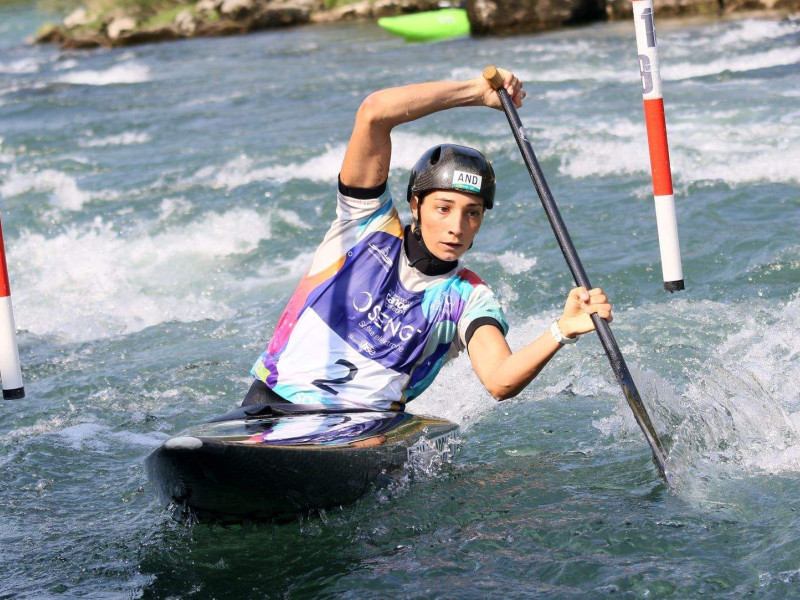
Few events at the 2026 Paddle Europe Canoe Slalom Championships have produced as much recent variety as women’s C1. Since 2020, the European title has changed hands every single year.
Gabriela Satkova won in 2020, Miren Lazkano in 2021, Mallory Franklin in 2022, Elena Lilik in 2023, Andrea Herzog in 2024 and Monica Doria in 2025. Six championships, six different champions.
Ivrea now sets up the possibility of a seventh different winner in seven editions — or the first repeat champion of this remarkable sequence.
Monica Doria arrives in Ivrea carrying the most recent European title.
The Andorran won the 2025 championship in Vaires-sur-Marne, ahead of Laurene Roisin of France and Doriane Delassus.
She is back in the 2026 field and will begin her title defence from a start list that contains several former European champions and one newly crowned world champion.
The final start list places Doria among the leading names in the event, alongside Tereza Kneblova, Zuzana Pankova, Miren Lazkano, Andrea Herzog, Klaudia Zwolinska, Mallory Franklin and Kimberley Woods.
The strongest new reference point in the field is Tereza Kneblova.
The Czech paddler arrives as the reigning women’s C1 world champion after winning the 2026 World Championships in Oklahoma City.
Her victory placed her ahead of Monica Doria and Klaudia Zwolinska, meaning the full World Championship podium will meet again in Ivrea.
That gives the European Championship a particularly interesting dynamic.
Doria holds the European crown. Kneblova holds the world crown. And Zwolinska arrives after another major international podium. All three are on the same start list.
Miren Lazkano brings another layer of history to the race.
When the European Championships were last held in Ivrea in 2021, Lazkano won the women’s C1 title.
She finished ahead of Tereza Fiserova and Elena Apel to become European champion on this course.
Five years later, she returns as the only one of the four traditional individual champions from Ivrea 2021 who is competing again at these championships.
The venue therefore carries a very different meaning for Lazkano than for most of the field.
She is not simply returning to Ivrea. She is returning to the course where she became European champion.
The pattern of six different winners does not mean the previous champions have disappeared.
Mallory Franklin, the 2022 European champion, is entered.
Andrea Herzog, champion in 2024, is also on the start list.
Lazkano brings the 2021 title, while Doria arrives as the defending champion from 2025.
That means four of the six champions from the 2020–2025 sequence are present in Ivrea.
Gabriela Satkova, the 2020 champion, and Elena Lilik, winner in 2023, are not in the current start list.
The question is therefore unusually simple: can one of the returning champions finally break the sequence and win again?
The Paris 2024 Olympic podium does not feature in this year’s European field Two were from outside of Europe and Elena Lilik(GER) is not attending. But that absence does not make the European race any less deep.
Alongside Doria, Kneblova, Lazkano, Franklin and Herzog, the field includes Klaudia Zwolinska, Zuzana Pankova, Marjorie Delassus, Kimberley Woods, Angele Hug, Alena Marx and several others with major championship experience.
The result is a category where the recent history offers almost no single dominant reference point.
Women’s C1 has spent the last six European Championships resisting repetition.
Different athletes. Different countries. Different generations. And every year since 2020, a new champion.
Ivrea now provides the next test of that pattern.
Doria can become the first athlete in this sequence to successfully defend the title.
Lazkano, Franklin or Herzog can become the first repeat winner since this six-year run began.
Or another name — perhaps Kneblova, fresh from a world title — can extend the streak to seven different champions in seven editions.
Whatever happens, women’s C1 arrives in Ivrea with one of the clearest historical questions of the championships:


© 2021 ECA