Waste management, sustainable mobility and responsible use of materials emerged as some of the strongest areas in the sustainability assessment of the 2026 European Championships, with an overall average score of nearly 70% across the six events evaluated so far.
The results mark an important step towards more sustainable canoeing competitions in Europe and come alongside a major institutional development: the voting of the Paddle Europe Sustainability Policy 2027–2035 by the Board of Directors during its meeting in Dublin on 14–15 November 2026. The strategy will now be submitted for final approval at the Paddle Europe Congress in April 2027.
Measuring Sustainability Through the DECK Project
The 2026 assessments were carried out using the Sustainability Rating Tool developed through the DECK Project (Developing Environmental and Circular Knowledge), a European initiative co-funded by the Erasmus+ Sport programme and supported by Paddle Worldwide and several National Canoe Federations. The project provides practical tools and resources to help sporting organisations measure their environmental impact, adopt more sustainable practices and improve event management.
By introducing this tool across European Championships, Paddle Europe has taken an important step towards consistent sustainability monitoring and evidence-based improvements. The project will continue through DECK UP, scheduled to begin in 2027, with the aim of further developing the platform and its assessment capabilities.
2026 Sustainability Review: Strengths and Areas for Improvement
The assessment covered nine categories, including waste management, mobility, materials, food, energy, biodiversity, accommodation, environmental measures and communication.
Waste management achieved the highest average score (92.5%), with several Championships reaching 100%, reflecting strong practices in waste separation, recycling and responsible resource management.
Other positive results were recorded in mobility (78.5%), materials (77.9%) and food management (76.9%), demonstrating encouraging progress in several operational areas.
However, the results also identified important opportunities for improvement. Environmental criteria recorded the lowest average score (48.2%), followed by accommodation (55.7%) and biodiversity (64.7%).
These findings underline the need for stronger environmental planning, more sustainable accommodation solutions and greater attention to biodiversity protection.
Rather than comparing individual organisers, the objective is to use these results to share knowledge, identify effective solutions and encourage continuous improvement across European Championships.
Sustainability in Action: Inspiring Initiatives from 2026
Beyond the assessment scores, several initiatives demonstrated how European Championships can contribute positively to the environment and local communities.
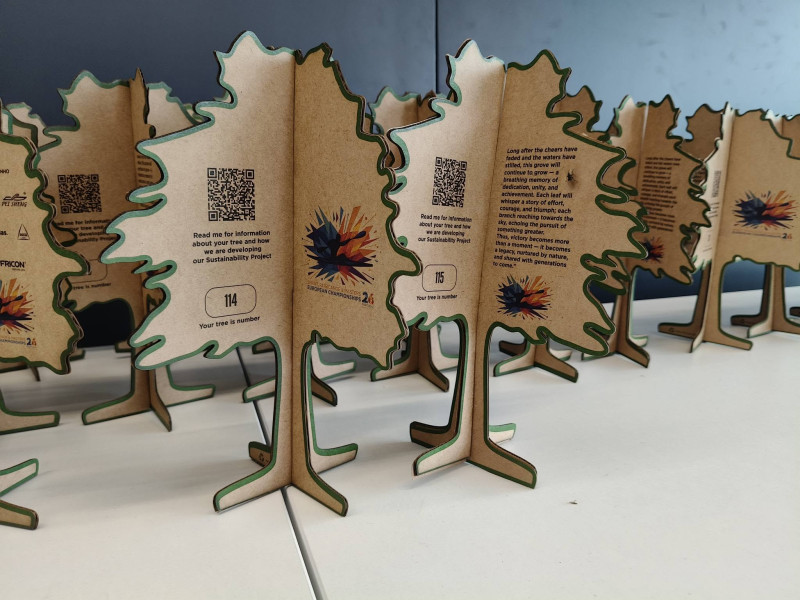
At the European Sprint and Paracanoe Championships in Montemor-o-Velho, Portugal, organisers developed a tree-planting initiative based on the principle of one tree for every medal awarded. Following the severe storms and flooding that affected the region, the project connected sporting achievements with environmental recovery and the restoration of the local landscape.
Another example combined recycling with social inclusion. Old promotional banners were transformed into reusable bags by women in prison, giving materials a second life while supporting social reintegration and providing opportunities to develop practical skills.
Local community engagement was also highlighted through an initiative involving massage therapists from across a host city, who were invited to showcase their different specialities and professional services during the Championships.
These examples illustrate how sustainability extends beyond environmental protection, creating opportunities for social inclusion, local economic activity and stronger connections between sporting events and their host communities.
Looking Ahead: The Paddle Europe Initiative 2027–2035
The proposed Board strategy, known as the Paddle Europe Initiative, establishes a long-term vision for more sustainable European canoeing, combining environmental protection, social responsibility and good governance.
Its priorities include reducing the environmental impact of competitions, protecting natural environments, encouraging responsible resource consumption and gradually integrating sustainability requirements into European Championship planning and organisation.
The experience gained in 2026 will provide a valuable foundation for these efforts, while closer cooperation with National Federations, Organising Committees and partners will help turn objectives into practical actions.
The 2026 review is an encouraging starting point, demonstrating that meaningful progress is possible through cooperation, practical initiatives and a shared commitment to a more sustainable future.
 19.11.2026