We use cookies to improve our site and your experience. By continuing to browse our site you accept our cookie policy
We use cookies to improve our site and your experience. By continuing to browse our site you accept our cookie policy
 23.8.2026
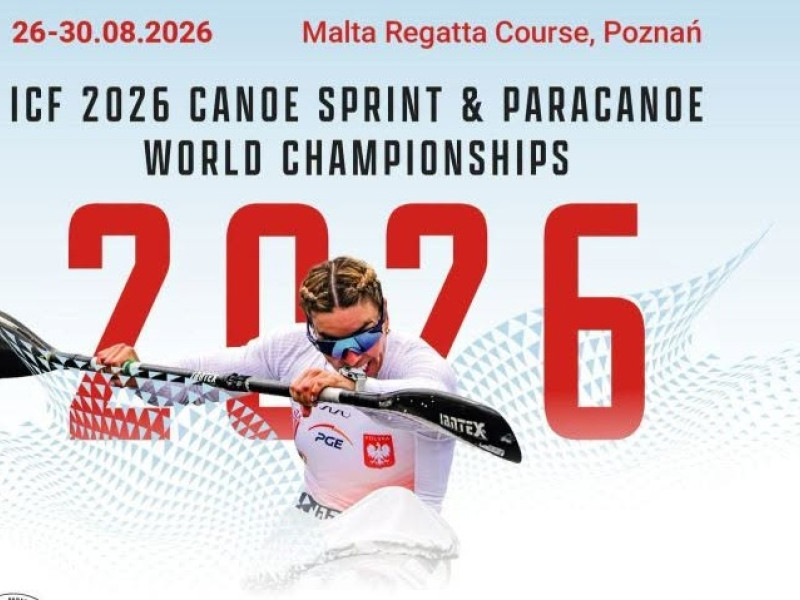
854 athletes representing 77 National Federations, plus Individual Neutral Athletes, are entered for the five-day championships, which begin on Wednesday morning with the heats of the men’s C1 1000m.
European paddlers make up the majority of the field. European representation stands at 501 of the 854 competitors – 58.7 per cent of the entire start list.
Spain has the largest European athlete entry with 44 competitors, followed by Hungary with 37, host nation Poland with 36, Germany with 34, Italy with 32, Ukraine with 30, Czechia with 25 and Great Britain with 22.
The scale of the championship is even more evident in the accreditation figures. A total of more than 1,400 people are accredited within National Federation delegations, including athletes, coaches, team staff and other officials. Of those, 907 are part of European delegations, meaning almost two thirds of all delegation accreditations belong to Europe.
Germany brings the largest European delegation overall with 79 accredited team members, followed by Spain with 75 and Poland with 71. Hungary and AIN each have 68, Italy 62 and Ukraine 57.
If last year is anything to go by, European athletes will once again be at the heart of the battle for medals.
At the 2025 World Championships in Milan, European athletes won 31 of the 36 world titles when AIN competitors are included in the continental total – 86.1 per cent of all gold medals awarded.
Europe also collected 78 of the 108 available medals, underlining the depth of the continent across both Canoe Sprint and Paracanoe.
Hungary was the most successful European National Federation, finishing the championships with seven gold medals, three silver and five bronze. Great Britain followed with four world titles, while Ukraine also claimed four gold medals.
Spain collected eight medals in total, while Poland and Czechia both won two world titles. Portugal, Germany, Georgia, Moldova, Sweden and Denmark also finished the championships with world champions.
AIN athletes added another five gold medals to the European total.
Several of the athletes responsible for that success will now attempt to defend their titles in Poznań.
For the host nation, Anna Puławska will be one of the major names to watch. The Polish paddler won the K1 Women 500m world title in Milan before adding another gold alongside Martyna Klatt in K2 Women 500m. Both are back in Poznań and will again race together in the K2.
Hungary arrives with another formidable group of defending champions.
Bálint Kopasz returns after winning the K1 Men 1000m title in Milan, where he finished ahead of Australia’s Thomas Green and Portugal’s Fernando Pimenta.
Zsóka Csikós, world champion in the K1 Women 1000m, will also be back in action, while Peter Kiss returns to defend his KL1 Men 200m title.
Hungary’s strength in the crew boats was another feature of Milan 2025. The country won the K2 Men 500m, C4 Men 500m and C4 Women 500m titles, and many of the athletes involved in those victories are again entered in Poznań.
Ukraine’s Liudmyla Luzan produced one of the standout performances of last year’s championships, winning four world titles.
Luzan became world champion in both the C1 Women 500m and 200m and also won the C2 Women 500m and 200m alongside Iryna Fedoriv.
She returns to Poznań in the C1 Women 200m and in both C2 events, although this time she will race with Anastasiia Rybachok, giving Ukraine a new combination for its title defence.
Czechia will also have two major individual champions back on the start line.
Martin Fuksa returns after taking the C1 Men 1000m world title ahead of Greece’s Stefanos Dimopoulos and Hungary’s Balázs Adolf.
In kayak, Josef Dostál will attempt to defend the K1 Men 500m title he won by just nine hundredths of a second over Hungary’s Adam Varga.
Portugal and Spain also return with much of the crews that delivered two of the closest finals of the 2025 championships.
Portugal won the K4 Men 500m title by only 0.05 seconds over Hungary, with Gustavo Gonçalves, João Ribeiro, Messias Baptista and Casinha all returning in Poznań.
Spain’s women won the K4 500m title by just 0.10 seconds ahead of China. Sara Ouzande, Lucia Val and Barbara Pardo are back in the boat, joined in 2026 by Daniela García Heredia.
The AIN team will also bring several defending world champions to Poznań.
Zakhar Petrov was one of the leading canoe athletes in Milan, winning the C1 Men 500m before adding a second gold together with Ivan Shtyl in C2 Men 500m.
Petrov will not defend the C1 500m title this year, but he is entered in the C1 Men 1000m and will again race alongside Shtyl in C2 Men 500m.
Paracanoe will also see the return of Ilya Taupianets, the defending VL1 Men world champion, and Anastasia Miasnikova, who won the VL2 Women title last year.
The fifth AIN world title in Milan came from Volha Klimava in C1 Women 5000m, although she does not appear on the current Poznań start list.
Europe’s strength was equally clear in Paracanoe in 2025.
Great Britain collected four world titles, with Charlotte Henshaw, Laura Sugar, David Phillipson and Hope Gordon all winning gold.
Henshaw, Phillipson and Gordon return to Poznań, while Sugar does not appear on the latest start list.
Georgia’s Serhii Yemelianov, winner of the KL3 Men 200m world title, will also defend his crown in Poland.
Germany will have Chinette Karina Lauridsen on the start line after her 2025 VL1 Women world title, although she is entered this year in VL2 Women.
The closing afternoon in Poznań will once again belong to the 5000m races, and all three European National Federation champions from Milan are back.
Moldova’s Serghei Tarnovschi returns after winning the C1 Men 5000m title, Sweden’s Melina Andersson will defend the K1 Women 5000m crown, and Denmark’s Mads Brandt Pedersen will line up as reigning K1 Men 5000m world champion.
For Tarnovschi, Poznań offers another opportunity to challenge across more than one distance, with the Moldovan also entered in the C1 Men 1000m.
The World Championships begin on Wednesday, 26 August, with a busy programme of heats across both Canoe Sprint and Paracanoe.
The first race of the championships will be the C1 Men 1000m at 09:00, followed during the day by events including the K4 Men and Women 500m, C2 Women 500m and a wide range of individual Sprint and Paracanoe races.
Thursday, 27 August continues the qualification phase, with heats and semifinals across the programme, including K1 and C1 Women 200m, K1 Men 500m, C2 Men 500m and K2 Men and Women 500m.
The first medals will be awarded on Friday, 28 August, when eight world titles are scheduled.
The championships then move into two intense medal days. Saturday, 29 August will feature 13 world title races, before Sunday, 30 August brings the final 15 titles.
The championships conclude with the four 5000m finals – C1 Women, C1 Men, K1 Women and K1 Men – on Sunday afternoon.
Poznań will also carry importance well beyond the medals awarded this week.
The championship takes place during the first season of the new qualification pathway towards the Los Angeles 2028 Olympic Games, with the Canoe Sprint Olympic Qualification Ranking already underway.
The ranking period began on 20 April 2026 and runs until the end of 2027, with results from World Championships, World Cups and Continental Championships contributing towards Olympic qualification. The Olympic Ranking will eventually allocate 162 of the 236 Canoe Sprint athlete quota places available for LA28.
That gives this World Championships an added strategic importance for European teams.
Heading into Poznań, Europe is already in an exceptionally strong position, leading nine of the ten Olympic Canoe Sprint event rankings.
Hungary currently leads Men’s K4, Germany Men’s K2, Portugal Men’s K1, Spain Men’s C2 and Czechia Men’s C1. On the women’s side, Germany leads K2, Sweden K1 and Ukraine both C2 and C1.
China, in the Women’s K4, is currently the only non-European leader among the ten Olympic events.
The same applies in Paracanoe, where the LA28 Paralympic Ranking is also already underway.
The ranking period runs from May 2026 until May 2028, with an athlete’s best five results counting towards qualification. World Championships carry a 1.5 ranking-points multiplier, making Poznań one of the most valuable competitions of the cycle.
For European athletes and National Federations, the next five days therefore offer much more than the possibility of becoming world champion.


© 2021 ECA