We use cookies to improve our site and your experience. By continuing to browse our site you accept our cookie policy
We use cookies to improve our site and your experience. By continuing to browse our site you accept our cookie policy
 23.9.2026
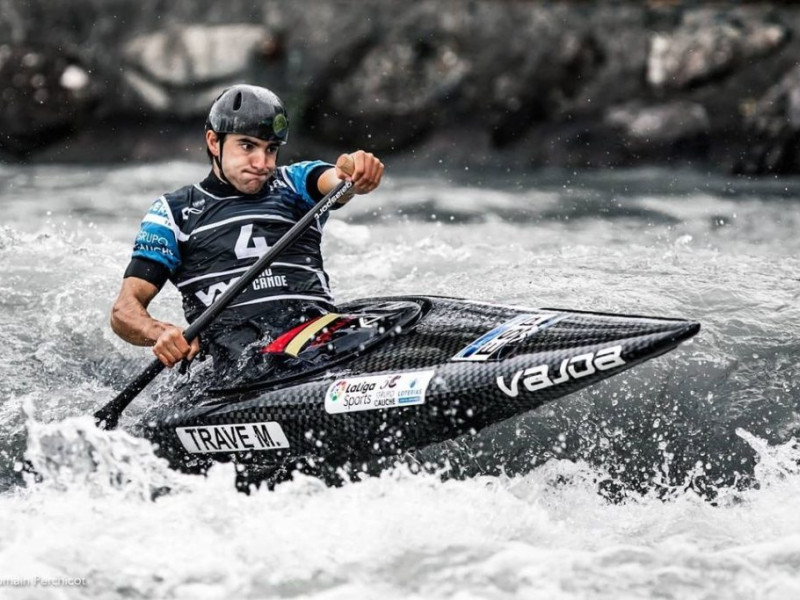
Few events at the 2026 Paddle Europe Canoe Slalom Championships illustrate the depth of the field better than men’s C1.
The start list contains 47 athletes, headed by some of the most decorated names in the discipline. Among them are the reigning Olympic champion, the reigning world champion, the defending European champion and the complete Paris 2024 Olympic podium. And at the centre of the story is Spain’s Miquel Travé.
Travé arrives in Ivrea holding two of the biggest titles available in European canoe slalom. He won the men’s C1 European title in 2025 and followed it this season by becoming world champion in Oklahoma City.
That combination gives him the opportunity to defend his European crown only weeks after reaching the top of the world.
The Spaniard’s rise has been one of the major stories in men’s canoe over the last two seasons.
At the 2025 European Championships in Vaires-sur-Marne, Travé claimed the European title ahead of Nicolas Gestin. He then confirmed that form on the world stage in 2026, winning the World Championship final in Oklahoma City ahead of Adam Burgess and Lukas Kratochvil.
Ivrea now gives him another immediate test.
Standing at the top of the current world ranking in the provisional start list is France’s Nicolas Gestin, with Travé ranked second.
Their rivalry already carries an unusual combination of recent European, World and Olympic history.
Gestin comes to Ivrea with the biggest title of all.
At Paris 2024, the Frenchman became Olympic champion in men’s C1, finishing ahead of Great Britain’s Adam Burgess and Slovakia’s Matej Beňuš. All three are entered in Ivrea.
It means the complete Olympic podium will meet again at the European Championships.
Gestin arrives as Olympic champion. Burgess is the Olympic silver medallist and has since added a World Championship silver medal in 2026. Beňuš, one of the most experienced athletes in the field, returns as the Olympic bronze medallist.
Travé himself was fifth at Paris 2024.
Two years later, the balance has shifted: he is now the reigning European and world champion, while Gestin remains the reigning Olympic champion.
That gives the Ivrea race a particularly strong storyline: the holders of all three major individual crowns — Olympic, World and European — are on the same start list.
Adam Burgess also arrives with one of the strongest recent records in the field.
After taking Olympic silver in Paris, the British canoeist again finished second at the 2026 World Championships, this time behind Travé.
He is therefore the only athlete to have finished on the podium at both of those major championships.
His presence adds another layer to a field in which very little separates many of the leading athletes.
The depth does not end with the recent major championship medallists.
Slovenia’s Benjamin Savšek, a former Olympic champion, is also entered, alongside Luka Božič and Ziga Lin Hočevar. The Slovenian trio also appears together in the men’s C1 team competition.
Czechia brings Vaclav Chaloupka, Lukas Kratochvil and Lukas Rohan. Kratochvil arrives in Ivrea after taking bronze at the 2026 World Championships.
Italy will look to Raffaello Ivaldi, Flavio Micozzi and Elio Maiutto, while Great Britain, Slovakia, France, Spain and Slovenia all arrive with deep three-athlete line-ups for the team event.
The result is a race where even reaching the final will require beating athletes with Olympic, World and European medals already on their résumés.
The course itself brings another historical connection.
Matej Beňuš was already on the men’s C1 podium when the European Championships were last held in Ivrea in 2021, taking silver behind Denis Gargaud Chanut.
Five years later, he returns as an Olympic medallist and one of the senior figures in a field that has evolved considerably since that championship.
Several of the younger athletes who were still developing in 2021 now arrive as major international champions.
That contrast between experience and a new generation is one of the defining characteristics of the 2026 field.
By the time the men’s C1 final begins, the European title will be decided between a field containing the reigning Olympic champion, reigning world champion, defending European champion, all three Paris Olympic medallists and several other major championship winners.
Travé will try to defend the European title he won in 2025.
Gestin will attempt to add a European crown to his Olympic title.
Burgess and Beňuš return with Olympic medals and more recent international success behind them.
And around them is a field deep enough to ensure that the story may not belong only to the names who arrive with the biggest titles.
Men’s C1 in Ivrea will not simply bring Europe’s leading canoeists together. It will bring almost every major recent storyline in the discipline onto the same course.


© 2021 ECA