We use cookies to improve our site and your experience. By continuing to browse our site you accept our cookie policy
We use cookies to improve our site and your experience. By continuing to browse our site you accept our cookie policy
 30.8.2026
Nine boats reached the Men’s K2 500m World Championship Final A in Poznań. Nine European flags lined up on the start line. Germany. Portugal. Czechia. Hungary. Norway. Belgium. Slovenia. Spain. Italy.
In one of the Olympic programme’s most competitive crew events, Europe occupied every lane in Sunday’s medal race.
And when the final was over, the podium had produced three very different national milestones. Germany returned to a world title it had not won for 19 years. Portugal extended one of the most consistent World Championship sequences in its canoe sprint history. And Czechia reached a Men’s K2 500m World Championship podium for the first time.
Germany returns to the top after 19 years
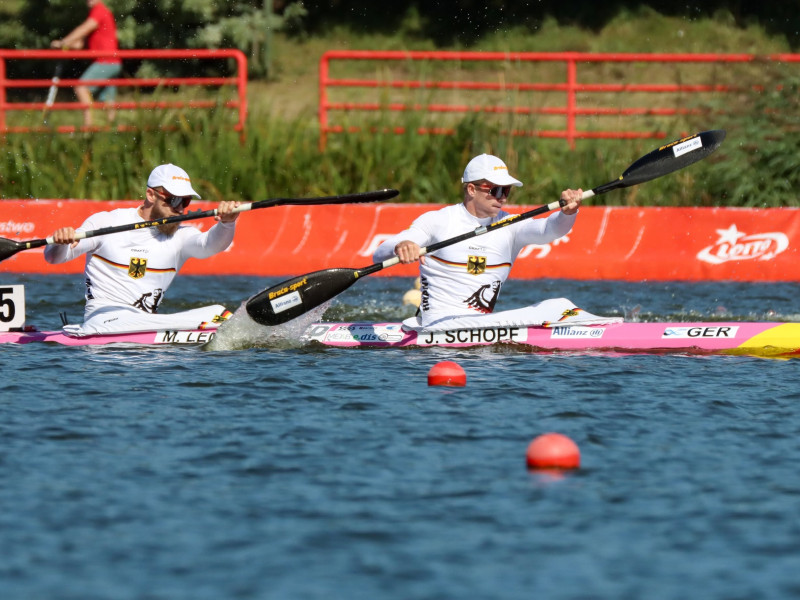
Jacob Schopf and Max Lemke left little doubt about their intentions.
The German pair were already leading at halfway, passing 250 metres in 41.88, the fastest split of the field.
Portugal followed in 42.29, while Hungary and Norway remained close behind.
But Schopf and Lemke produced an even more impressive second half and crossed the line in 1:27.57, winning by 1.72 seconds.
For Germany, the result ended a long wait.
The country had not won the Men’s K2 500m World Championship title since Ronald Rauhe and Tim Wieskötter became World Champions in Duisburg in 2007.
Nineteen years later, two athletes from another highly successful German generation have returned the title to Germany.
2007 – Ronald Rauhe / Tim Wieskötter
2026 – Jacob Schopf / Max Lemke
The connection between the two generations is significant.
Rauhe and Wieskötter were among the defining German kayak crews of their era.
Schopf and Lemke arrive with a different but equally impressive background. Both are Olympic champions through Germany’s successful Men’s K4 500m programme and have now also established themselves as one of Europe’s leading K2 crews.
Their 2026 season had already provided evidence of what was coming.
They became European Champions in the K2 500m at the Paddle Europe Championships in Montemor-o-Velho in June.
Two months later they have added the world crown.
European Champions in June.
World Champions in August.
And Germany has its first Men’s K2 500m world title since 2007.
Portugal refuses to leave the podium
If the German story is about returning to the top, Portugal’s is about remarkable continuity.
João Ribeiro and Messias Baptista were second from the opening half of Sunday’s final.
Their 42.29 split at 250 metres placed them immediately behind Germany, and they maintained that position through the second half to finish in 1:29.29.
The result delivered another World Championship silver.
But its real significance becomes clearer when placed alongside the previous editions.
2023 Duisburg – World Champions
2025 Milan – World silver
2026 Poznań – World silver
Three consecutive World Championships.
Three consecutive K2 500m medals.
And the same Portuguese crew every time.
No Portuguese Men’s K2 500m crew had previously achieved such a sequence at World Championship level.
Ribeiro and Baptista have therefore moved beyond the significance of their 2023 world title.
That result showed they could become the best crew in the world.
What has followed has demonstrated something equally difficult: their ability to remain there.
For Portugal, three consecutive World Championship podiums in the same event also place their achievement in rare company.
Only Fernando Pimenta had previously managed a comparable sequence of World Championship podiums for Portugal across consecutive editions in the same event.
Now Ribeiro and Baptista have added a crew boat to that history. Gold. Silver.Silver.
Three years of World Championship consistency in an Olympic event where margins are often measured in fractions of a second.
Czechia goes from last at halfway to the podium
The third story of Sunday’s final may have been the most dramatic of all.
At 250 metres, Jakub Špicar and Daniel Havel were last.
Not outside the podium positions.
Not fifth or sixth. Ninth.
Their halfway split of 44.20 was the slowest among all nine Final A crews. Germany was already more than two seconds ahead. Portugal was second. Hungary, Norway, Spain, Belgium, Slovenia and Italy were all ahead of Czechia.
Then Špicar and Havel produced a remarkable final 250 metres.
One by one, the Czech boat moved through the field. By the finish, Czechia had climbed six positions, crossing the line third in 1:29.94. Only 0.28 seconds separated them from fourth-placed Hungary, while Norway was another 0.05 behind.
The medal battle could hardly have been tighter.
But Špicar and Havel had done enough. And the reward was historic. For the first time, Czechia had reached the World Championship podium in the Men’s K2 500m.
A breakthrough that had been building
The Czech pair had already shown that they could compete at this level.
At the 2023 World Championships in Duisburg, Špicar and Havel reached the Final A and finished fifth.
They were close, but not yet on the podium.
Their 2025 World Championships were more difficult, but the current season brought another clear step forward.
In June, they stood on the podium at the Paddle Europe Championships in Montemor-o-Velho, taking European bronze.
Two months later:
European bronze – Montemor-o-Velho
World bronze – Poznań
The result confirms their progression, but the manner in which they achieved it made the moment even more memorable.
From ninth at halfway to third at the finish.
From chasing the field to making Czech K2 history.
Three nations, three different milestones
The podium in Poznań therefore represented much more than gold, silver and bronze.
For Germany, Jacob Schopf and Max Lemke ended a 19-year wait stretching back to Ronald Rauhe and Tim Wieskötter.
For Portugal, João Ribeiro and Messias Baptista extended an unprecedented run of three consecutive Men’s K2 500m World Championship podiums.
For Czechia, Jakub Špicar and Daniel Havel produced a spectacular second half to deliver their country’s first-ever World Championship medal in the event.
And the European depth went far beyond the podium.
Hungary finished fourth in 1:30.22, only 0.28 seconds away from bronze.
Norway was fifth, another 0.05 behind.
Belgium finished sixth, Slovenia seventh, Spain eighth and Italy ninth.
Nine Final A positions. Nine European crews. Three European nations on the podium.
An Olympic event dominated by Europe
The significance is even greater because the Men’s K2 500m is not simply another World Championship race.
It is an Olympic event.
And two years before Los Angeles 2028, Sunday’s final demonstrated the extraordinary depth that currently exists across European men’s kayak.
Germany has returned to the top.
Portugal continues to deliver World Championship medals year after year.
Czechia has broken through.
Immediately behind them are Hungary and Norway, while Belgium, Slovenia, Spain and Italy all reached the World Championship Final A.
The medals may have produced three individual national stories.
Together, however, they told an even bigger one.
Germany ended a 19-year wait. Portugal made it three World podiums in a row. Czechia reached the podium for the first time.
And all of it happened in a World Championship final made entirely in Europe.



© 2021 ECA