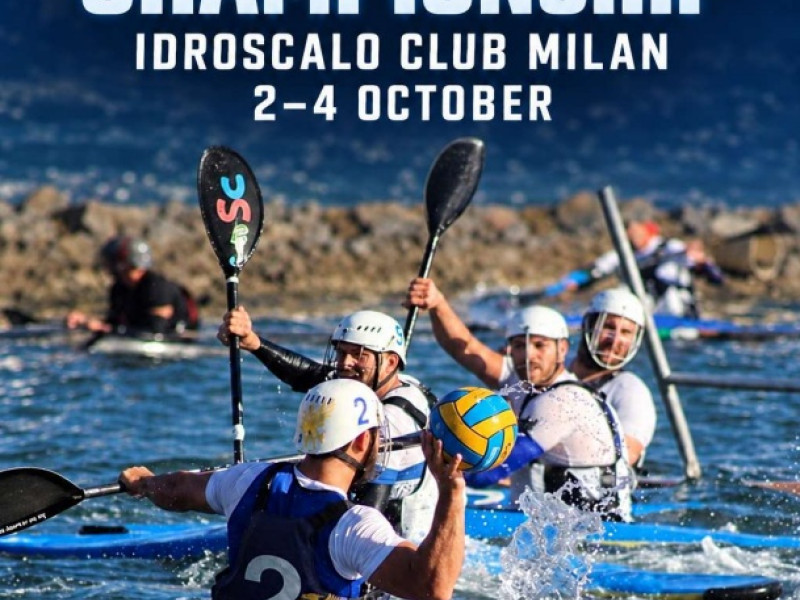
From Friday 2 to Sunday 4 October, 25 men's teams and 15 women's teams will compete for the European club titles, with an intensive programme of 168 matches scheduled across four pitches.
The Championships bring together some of Europe's leading canoe polo clubs at one of Italy's best-known watersport venues, just two weeks after European nations dominated the ICF Canoe Polo World Championships in Duisburg.
European canoe polo returns to the spotlight
The event comes at an exceptional moment for European canoe polo.
At the recent World Championships in Duisburg, European national teams secured all four world titles, with Italy winning the Senior Men's competition, Germany taking the Senior Women's crown, France triumphing in U21 Men and Spain becoming U21 Women's world champions.
European nations occupied ten of the twelve available podium positions.
Attention now moves from national teams to clubs as many players return to the water representing the organisations where they train and compete throughout the season.
The European Club Championships have their own identity, bringing together different canoe polo traditions from across the continent and creating three days of continuous competition before the new European champions are crowned on Sunday.
40 teams and 168 matches
The scale of this year's competition underlines the strength of the European club scene.
A total of 25 men's teams have been divided into four preliminary groups, while 15 women's teams will begin the tournament across three groups.
Together they will contest 168 matches:
- 108 in the men's competition
- 60 in the women's competition
Four pitches will operate simultaneously at Idroscalo throughout much of Friday and Saturday.
Competition begins at 12:00 on Friday, with 52 matches scheduled during the opening day.
Saturday will be the busiest day of the Championships, with 76 matches beginning from 07:30 and continuing through the decisive stages of both competitions.
The final 40 matches will take place on Sunday, culminating in the two European title matches.
Berlin return to defend men's crown
Germany's KSVH Berlin arrive in Milan as defending men's European club champions.
Berlin claimed the 2025 title in Kaniów, Poland, defeating FOA Liverpool 2–1 in the final after also overcoming Avranches by the same score in the semi-final.
Liverpool will not compete in Milan this year, but several clubs that occupied leading positions in 2025 return for another challenge.
Third-placed Avranches are back, as are Powiśle Warszawa, who finished fourth, and Real Club Náutico Castellón, fifth last season.
Corbeil-Essonnes, Odysseus, Clube Fluvial de Coimbra and Napoli are among the other returning clubs from last year's leading positions.
The defending champions have been drawn in Group A alongside Deventer, Corbeil-Essonnes, Branik, Clube Fluvial de Coimbra and Kilkenny.
Another group with significant recent European experience is Group D, which includes Warszawa, Castellón and Napoli together with Gent, Linköping, Ulster and Zürich.
Group C features Praha, Skovshoved, KGV Essen, Málaga, Chiavari and Poznań, while Avranches headline Group B.
Women's competition grows significantly
One of the most notable developments in Milan is the growth of the women's competition.
The 2025 Championships featured ten women's teams. This weekend 15 clubs will compete for the title, representing a 50 per cent increase in the size of the field.
Germany's 1. MKC Duisburg will defend the European crown after defeating ACIGNÉ N1D 1–0 in last year's final.
Avranches, who took bronze in Kaniów, also return alongside several other clubs from the 2025 competition, including Rovigo, Neptun and Burriana.
Duisburg begin in Group A together with Pont-d'Ouilly, Neptun, Ichnusa and Zürich.
Group B features Avranches, KRM Essen, Thurgauer, Burriana and Praha, while Alaquas, Kingston, Rovigo, Deventer and Mullingar make up Group C.
The competition format will see the leading teams progress into a second group phase on Saturday afternoon before the semi-finals and medal matches on Sunday.
Italian clubs ready for home challenge
Four Italian teams will have the opportunity to compete for European honours on home water.
Chiavari and Napoli represent the host nation in the men's competition, while Ichnusa and Rovigo will compete in the women's tournament.
They will race at the Idroscalo, a historic venue that has developed into one of Milan's major sport and recreation locations and has hosted numerous international watersport events.
Originally constructed between 1928 and 1930 as a seaplane airport, the lake is today widely known as the "Sea of Milan".
Every match counts
The men's format gives every team competition through until Sunday.
The four preliminary group winners will qualify directly for Saturday evening's quarter-finals.
Teams finishing second and third will enter crossover matches for the remaining four quarter-final positions, while the other teams continue through classification competitions determining every position down to 25th place.
The women's tournament follows a different route.
After the opening group phase, the top two teams from each group will form a six-team pool competing for positions 1–6. From there, the leading four teams will progress to Sunday's semi-finals.
Similar second-round competitions will determine positions 7–12 and 13–15.
The format means teams will remain active throughout the weekend and ensures a packed programme across all three competition days.
European titles decided on Sunday
Sunday morning will bring the decisive knockout matches.
The women's semi-finals are scheduled for 09:15, followed by the men's semi-finals at 09:50.
The medal matches will then take centre stage during the afternoon.
The women's bronze medal match begins at 13:45, followed by the women's European Club Championship final at 14:30.
The men's bronze medal match will also take place at 13:45 before the Championships conclude with the men's final at 15:15.
The medal ceremony will follow the conclusion of the competition.
After a season in which European canoe polo has once again demonstrated its strength internationally, Milan now offers the continent's leading clubs their opportunity to finish 2026 with one of the biggest titles in European club competition.
 2.10.2026