We use cookies to improve our site and your experience. By continuing to browse our site you accept our cookie policy
We use cookies to improve our site and your experience. By continuing to browse our site you accept our cookie policy
 20.9.2026
Six days of competition at the 2026 Canoe Polo World Championships came to an end on Sunday in Duisburg, Germany, with Europe completing a remarkable Championships.
Four different European nations were crowned world champions: Italy in Senior Men, Germany in Senior Women, France in U21 Men and Spain in U21 Women.
Of the 12 medals available across the four competitions, 10 went to European teams, with New Zealand's two silver medals – in U21 Men and U21 Women – the only places on the podium taken by a nation from outside Europe.
Europe therefore finished Duisburg with 100 per cent of the world titles and 83.3 per cent of all medals.
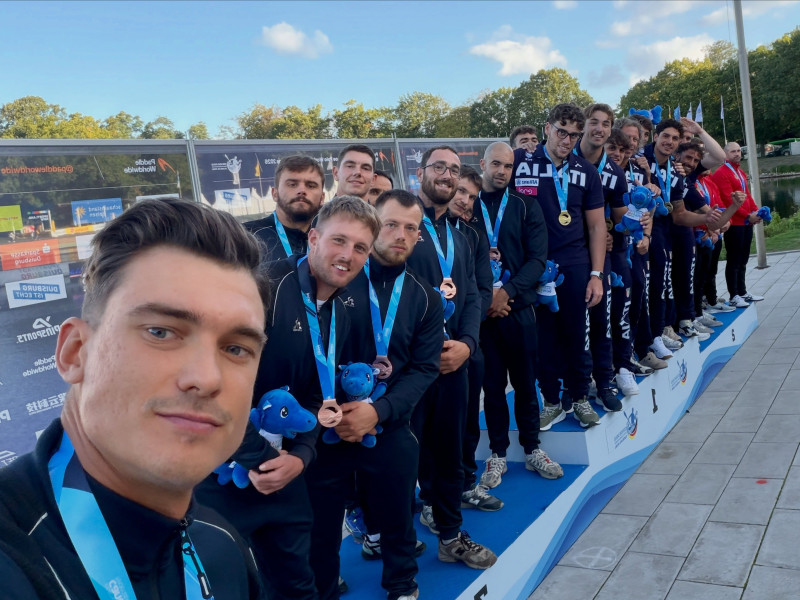
The Senior Men final provided a dramatic conclusion to the Championships, as Italy defeated hosts and three-time defending champions Germany 4-3 after extra time.
Germany had arrived in Duisburg chasing a fourth consecutive world crown after winning in 2018, 2022 and 2024, and progressed strongly through the competition. Before the final, the hosts had also beaten Italy 5-3 during the second round.
But the Italians produced the result that mattered most.
With the final locked at 3-3, Italy eventually found the decisive goal in the second period of extra time to return to the top of the world podium exactly ten years after winning their first Senior Men world title on home water in Syracuse in 2016.
France completed an entirely European podium by taking bronze, while Great Britain finished fourth.
The final classification further demonstrated Europe's strength. The first five positions were all occupied by European nations – Italy, Germany, France, Great Britain and Switzerland – before New Zealand in sixth. The Netherlands, Denmark, Spain, Poland and Portugal also finished inside the top 11.
There was home success in the Senior Women competition, where Germany produced an emphatic performance in the gold-medal match to defeat France 8-1.
The victory returned Germany to the top of the world podium after New Zealand had taken the title in 2024 and gave the German women's programme its eighth World Championship crown.
Germany were impressive throughout the week and finished the Championships by delivering their strongest performance when it mattered most.
France also completed an excellent Championships with silver, while Great Britain took bronze and Poland finished fourth.
Once again, the top of the standings was dominated by European nations. The first seven positions all went to Europe: Germany, France, Great Britain, Poland, the Netherlands, Spain and Italy.
Germany's gold also completed a remarkable turnaround from the 2024 World Championships, when they finished fifth, while France improved from ninth in Deqing to world silver medallists in Duisburg.
France celebrated their first U21 Men's world title in 12 years after defeating New Zealand 7-2 in Saturday's final.
Nielsen Ruas and Gabriel Asselin helped France build an early advantage, before the French team pulled clear in the second half to secure their first title in the category since 2014.
Their route to gold included a 3-1 semi-final victory over Germany. New Zealand reached the final after overcoming the Netherlands 4-3 after extra time in the other semi-final.
Germany recovered to claim bronze with a 2-1 victory over the Netherlands, giving Europe two of the three medals in the category.
France finished first, ahead of New Zealand and Germany, with the Netherlands fourth and Poland fifth. Switzerland, Spain, Denmark, Italy, Great Britain and Belgium also followed in the final classification, meaning 10 of the first 11 teams were European.
The result also ended Spain's two-edition reign as U21 Men's world champions. The 2022 and 2024 winners eventually finished seventh in Duisburg.
Spain supplied another major European success by winning the U21 Women's world title for the first time in the nation's history.
The Spaniards completed an unbeaten campaign with a 3-1 victory over New Zealand in the final.
Captain Valentina Nogueira Lovatto opened the scoring before New Zealand levelled, but two goals from Ines Arosa Soto ultimately secured Spain's historic title. Nogueira Lovatto finished the winning campaign with 19 goals.
Spain had shown their strength throughout the Championships. They defeated Germany 8-4 during the competition and beat Italy 3-2 and New Zealand 3-1 on their way to the semi-finals. A commanding 10-2 semi-final victory against defending champions France then booked their place in the gold-medal match.
Germany secured another European medal by beating France 2-1 in the bronze-medal match.
Spain therefore finished ahead of New Zealand, Germany and France, with Italy fifth, the Netherlands sixth and Great Britain seventh.
While four different European countries left Duisburg with world titles, Germany were the only nation to win a medal in every category.
The host nation collected one gold, one silver and two bronze medals. Germany won the Senior Women title, took silver in Senior Men and bronze in both U21 competitions.
France were also represented on three podiums, taking U21 Men gold, Senior Women silver and Senior Men bronze.
| Nation | Gold | Silver | Bronze | Total |
|---|---|---|---|---|
| Germany | 1 | 1 | 2 | 4 |
| France | 1 | 1 | 1 | 3 |
| Italy | 1 | 0 | 0 | 1 |
| Spain | 1 | 0 | 0 | 1 |
| New Zealand | 0 | 2 | 0 | 2 |
| Great Britain | 0 | 0 | 1 | 1 |
| Europe total | 4 | 2 | 4 | 10 |
For Europe as a whole, the medal distribution could hardly have been stronger: four gold, two silver and four bronze medals.
One of the strongest statistics from Duisburg came from the two senior competitions.
All six Senior World Championship medals stayed in Europe.
In Senior Men, the podium was Italy, Germany and France. In Senior Women it was Germany, France and Great Britain.
The result extends Europe's extraordinary historical record in canoe polo. Before Duisburg, European nations had won 40 of the 48 official world titles contested across the four categories and 126 of the 144 World Championship medals awarded.
After the 2026 Championships, those figures have increased to 44 of 52 world titles – 84.6 per cent – and 136 of 156 medals – 87.2 per cent.
Germany also strengthen their position at the top of the historical European World Championship medal table. Their four medals in Duisburg take their total to 40 World Championship medals, while France move to 30.
The four final podiums in Duisburg were:
Senior Men – Italy
Gold: Italy
Silver: Germany
Bronze: France
Senior Women – Germany
Gold: Germany
Silver: France
Bronze: Great Britain
U21 Men – France
Gold: France
Silver: New Zealand
Bronze: Germany
U21 Women – Spain
Gold: Spain
Silver: New Zealand
Bronze: Germany
It was an especially significant Championships for Italy, who returned to the Senior Men's world title after ten years; for Germany, whose women collected an eighth world crown in front of the home supporters; for France, back on top of the U21 Men's competition after 12 years; and for Spain, whose U21 Women became world champions for the first time.
The Championships also provided another demonstration of the depth of European canoe polo. European teams filled 10 of the 12 podium positions, took all four titles and occupied the overwhelming majority of the leading positions across every final classification.


© 2021 ECA