We use cookies to improve our site and your experience. By continuing to browse our site you accept our cookie policy
We use cookies to improve our site and your experience. By continuing to browse our site you accept our cookie policy
 23.9.2026
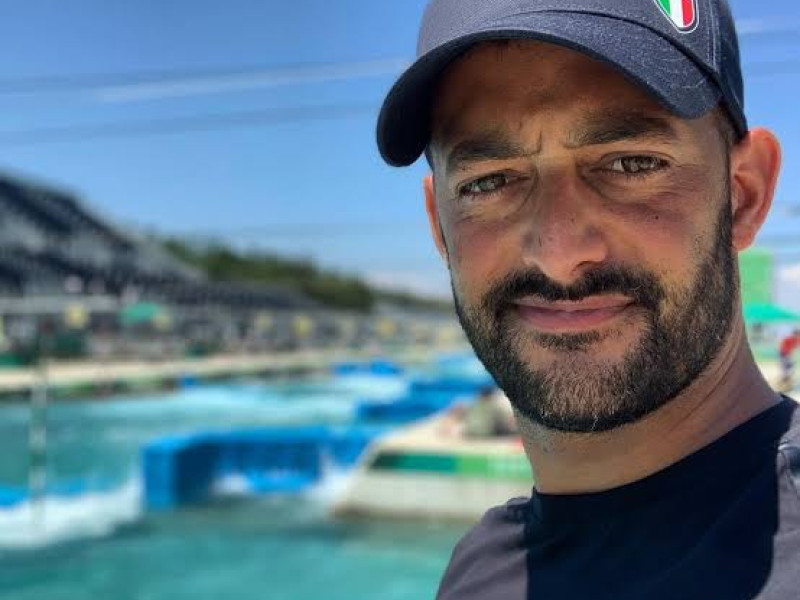
Few people are better placed to talk about the evolution of Italian canoe slalom than Daniele Molmenti.
Olympic champion in London in 2012, a two-time world champion and five-time European champion, Molmenti belongs to a remarkable line of Italian men’s kayak success that stretches from Pierpaolo Ferrazzi’s Olympic gold in Barcelona in 1992 to Giovanni De Gennaro’s victory at Paris 2024.
But Molmenti’s story did not end when he stepped out of the boat.
Today, he is helping shape the next chapter of Italian canoe slalom from the technical side, working with a national programme that returns to Ivrea for the 2026 Paddle Europe Canoe Slalom Championships with Olympic, world and European ambitions.
Ivrea also carries a special personal connection.
Ten years ago, Molmenti and De Gennaro stood together at the top of a major international race here, with the younger Italian taking victory ahead of the Olympic champion. Today, De Gennaro returns to the same venue as Olympic champion himself, while Molmenti watches from a very different position.
That transition — from athlete to leader, from winning medals to helping others win them — sits at the centre of Molmenti’s reflections.
He also looks beyond the Italian team, speaking openly about the challenges facing canoe slalom in Europe: access to suitable water, costs, coaching structures, development pathways and the need to create opportunities long before athletes reach the highest level.
Ahead of the start of competition in Ivrea, Paddle Europe spoke with Daniele Molmenti about his career, his legacy and the future of the discipline.
I think the most interesting thing is exactly that they are three different generations. There are more than thirty years between Pierpaolo’s Olympic gold and Giovanni’s, and this means that Italian success in kayak is not just one exceptional moment.
At the same time, I would not say that Italy has always had one single “school” or one rigid technical model. We have often been very good at developing strong individuals, athletes with personality, creativity and the ability to find their own way to be fast.
Pierpaolo was an inspiration for my generation. I tried to build my own path, and Giovanni did the same again. Different athletes, different periods, different ways of paddling, but maybe there is something very Italian connecting us: the ability to adapt, to fight, to find solutions and to perform when the moment really matters.
Now our challenge is to transform this tradition of great individuals into an increasingly strong and consistent system.
Of course I am proud of what I achieved. When you finish your career, the medals remain and they are part of your history. I worked for many years to achieve those results and I know how difficult every single one of them was.
But I have never been very interested in deciding who was the greatest. Different generations cannot really be compared. Equipment changes, courses change, rules change, training changes and the level of international competition changes.
What makes me happiest today is that my sporting story did not finish when I stopped racing.
Winning the Olympic Games as an athlete was something extraordinary. Then being part of a programme that helped another Italian athlete become Olympic champion gave me a completely different kind of satisfaction.
For me, success is not only about what you win yourself. It is also about what you are able to build and what you leave to the people who come after you.
As an athlete, everything is very simple in one sense: you are responsible for yourself.
You wake up thinking about your training, your body, your technique, your race. You can be quite selfish — and probably a high-level athlete needs to be.
When you become responsible for a team, the perspective changes completely. There is no longer one athlete and one performance. There are many athletes, coaches, clubs, military sports groups, specialists and different personalities that have to work together.
The biggest lesson for me has been understanding that you cannot coach or manage everybody in the same way.
My job today is not to tell every athlete exactly how to paddle. It is to create the best possible environment around the athletes and coaches, give them tools, challenge them when necessary and make different competencies work together.
You move from trying to be your best self to trying to help many other people become their best selves.
Yes, absolutely. Giovanni already had something special.
You could see his feeling for the water, his speed and his technical quality. But talent is only the beginning of the story.
What changed most over the years was his completeness as an athlete. Giovanni became much better at understanding himself, understanding races and managing all the small details that separate a very fast paddler from an Olympic champion.
He also learned patience.
This sport can be cruel because you can prepare extremely well for months or years and then one small mistake changes everything in a few seconds. To remain competitive for so many seasons, after disappointments as well as successes, requires enormous mental strength.
Looking back at us standing first and second here in Ivrea in 2016 is quite emotional now. At that moment I was approaching the end of my career and Giovanni was really beginning his international story. Ten years later our positions are completely different, but somehow we are still working towards the same objective.
Our relationship has naturally changed because our roles changed.
At the beginning we were athletes together. We trained, raced and competed against each other. Then I moved to the other side of the sport and had to learn that my experience could be useful, but it could never become a model that Giovanni simply had to copy.
This is very important.
I know what worked for Daniele Molmenti, but Giovanni De Gennaro has to be Giovanni De Gennaro.
Perhaps having lived some of the same situations helps me understand what an athlete feels before an important race, what kind of pressure exists and sometimes also when it is better not to say too much.
Helping someone achieve an Olympic dream that you have experienced yourself is special. When Giovanni won in Paris, there were emotions connected to my own career, of course, but above all there was satisfaction in seeing his journey completed and seeing the work of so many people rewarded.
Ivrea is one of those places where you immediately feel canoe slalom.
It has history, technical difficulty, passionate people and a course that athletes respect. I also have many personal memories here, both as an athlete and now from the technical side.
Having a major championship in Italy is extremely important.
Our sport needs places where people can see it closely and understand how spectacular it is. Television is important, social media is important, but when somebody stands beside a slalom course and sees an athlete attack a difficult rapid, change direction in a fraction of a second and fight against the water, they understand our sport differently.
For Italian canoe slalom, hosting the European Championships in Ivrea is both an opportunity and a responsibility. We want to show not only that Italy can produce great athletes, but also that we can organise and promote our discipline at a high international level.
Both.
Racing at home gives you energy. Athletes see Italian flags, hear people supporting them and feel that the event is something special.
But this can easily become additional pressure if you start thinking that because you are racing in Italy you have to demonstrate something.
Our work is therefore to make the championship important without making it different from what it really is: another high-level international race where the athlete has to execute his or her performance.
From the federation side, we have worked over the years to improve cooperation between national coaches, personal coaches, clubs, military sports groups and our scientific and performance support.
I strongly believe that high performance today is not created by one person. It comes from a network of people with different competencies moving in the same direction.
Of course we are competing to achieve results. At this level, medals matter and we should not pretend otherwise.
But I never want to evaluate a team only by counting medals at the end of one weekend.
I want to see athletes capable of reaching the decisive phases of the competition and expressing their real level when the pressure increases. Finals, consistency, quality of performance and the ability to compete for the top positions across different categories are all important indicators for us.
We have experienced athletes who can fight at the highest international level, but I am equally interested in seeing younger athletes reduce the distance from our leaders.
A strong national team cannot depend permanently on one or two names. The objective is to have internal competition, continuity and athletes pushing each other forward.
I am also very interested in the continued development of our canoe events and especially the women’s programme. Building depth across the entire team is fundamental for the next Olympic cycle.
I think the potential exists, but potential alone is never enough.
Italy has talented young athletes, very good coaches, strong clubs and important sports groups. What we need to continue improving is the connection between all these elements.
For many years canoe slalom depended heavily on the knowledge and passion of individual coaches and clubs. That remains extremely valuable, but modern high-performance sport also needs shared knowledge, data, sports science, long-term planning and better development pathways.
The objective cannot simply be to search for the next Ferrazzi, the next Molmenti or the next De Gennaro.
The objective should be to create a system capable of giving many talented young athletes the possibility to discover how good they can become.
And on the women’s side I think there is significant room for growth. We need depth, competition and continuity. That does not happen in one season; it requires investment and patience.
For me the first issue is accessibility.
Slalom is a fantastic discipline, but it has a high entry barrier. You need specific technical knowledge, coaches, equipment and, most importantly, access to suitable water.
We cannot expect every country to build an Olympic-level artificial course. We need to think about how athletes start the sport before they ever arrive on a World Cup course.
Natural rivers, smaller training facilities, movable gates, regional centres and simpler development competitions can all be part of the solution.
Costs are another major issue. If developing nations have to travel thousands of kilometres every time they want good-quality training or competition, the gap between established countries and developing countries will become larger.
I also think we have to protect the identity of slalom while making the sport easier to understand and promote. We should not change the sport every few years simply to make it look different. First we should make people know it, practise it and watch it.
National federations have the responsibility to create a base at home: clubs, coaches, young athletes and accessible activity.
Paddle Europe can help connect these national projects, share coaching knowledge, create development camps and support countries where the discipline is still small.
For me, growth does not start with the European Championships. It starts with a child getting into a kayak for the first time and finding a coach, a club and a place where he or she can come back the following week.
If we create more of those opportunities across Europe, participation at the top will eventually grow as a consequence.


© 2021 ECA