We use cookies to improve our site and your experience. By continuing to browse our site you accept our cookie policy
We use cookies to improve our site and your experience. By continuing to browse our site you accept our cookie policy
 29.8.2026
There is barely time for a mistake over 200 metres. A fraction of a second can separate a World Champion from the rest of the field, but behind some of the shortest races in canoe sprint are careers that have taken years to build.
Over the first two days of finals at the 2026 Canoe Sprint World Championships in Poznań, three European athletes provided very different examples.
For Poland's Oleksii Koliadych, victory confirmed his place among the great specialists of the C1 200m.
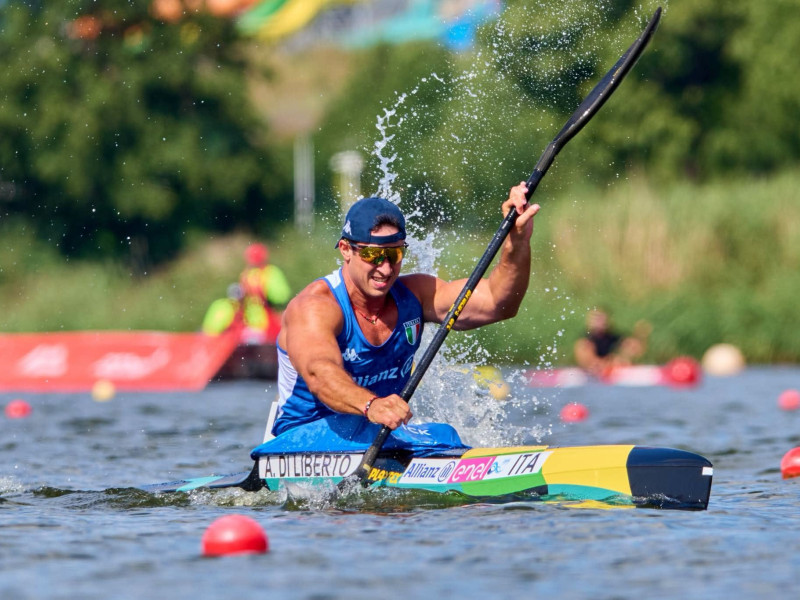
For Italy's Andrea Domenico Di Liberto, it marked a return to a title he first won five years ago.
And for Serbia's Marko Dragosavljević, silver finally brought a first senior World Championship medal after 13 years of trying.
The first story arrived on Friday.
With the Polish crowd behind him, Oleksii Koliadych won the Men's C1 200m in 40.95, edging Uzbekistan's Artur Guliev by just 0.10 seconds. The bronze went to Andrei Zholabau.
It was Koliadych's third World Championship title in the event, following his victories in Halifax in 2022 and Samarkand in 2024.
Three titles place him among an exceptional group in the history of the discipline. Only Valentin Demyanenko has won the Men's C1 200m world crown more often, with four victories between 2005 and 2013.
Koliadych's recent World Championship record is remarkable.
2022 – gold.
2023 – bronze.
2024 – gold.
2025 – fourth.
2026 – gold.
Three titles and four podiums across five World Championships.
And there was an element of reversal in Poznań.
At the 2025 World Championships in Milan, Guliev had taken the title while Koliadych finished fourth. One year later, the positions changed dramatically: the Polish canoeist was World Champion again, with Guliev taking silver.
The location also adds another dimension to his story.
Koliadych was born in Kherson, Ukraine, and moved to Poland in 2015 at the age of 17 to study and pursue greater opportunities in canoeing. He later gained Polish citizenship and has represented the country internationally since 2017.
Eleven years after arriving in Poland, he has now won a third world title while racing a World Championships on Polish water.
Twenty-four hours later came another journey back to the top.
Italy's Andrea Domenico Di Liberto won Saturday's Men's K1 200m final in 34.15, finishing 0.57 seconds ahead of Serbia's Marko Dragosavljević, with Spain's Carlos Arévalo taking bronze in 34.98.
For Di Liberto, it was a familiar feeling after a long wait. He first became World Champion in the K1 200m in Copenhagen in 2021.
That victory had considerable significance for Italian canoe sprint. Di Liberto's gold, together with the C2 500m title of Daniele Santini and Nicolae Craciun, ended a 20-year wait for an Italian Canoe Sprint World Championship title.
The previous Italian to reach the top of a World Championship podium had been the legendary Josefa Idem.
And where had Idem won in 2001? Poznań.
She captured both the K1 500m and K1 1000m titles here. Twenty years later, Di Liberto helped end the drought in Copenhagen. Now, another five years on, the Italian has become World Champion again on the same Poznań waters where Italy's previous golden chapter had been written.
There had already been signs that Di Liberto was moving back towards the top.
At his home World Championships in Milan last year he took silver in the K1 200m, just 0.25 seconds behind Hungary's Kolos Csizmadia. After what Di Liberto himself described as a difficult year, he called that medal a new starting point.
Twelve months later, that starting point has led him back to gold.
2021 – World Champion.
2025 – World silver.
2026 – World Champion.
Yet perhaps the most personal story of the three belongs to the man who finished immediately behind Di Liberto.
Marko Dragosavljević has known what it means to win.
He was European Champion in the K1 200m in both 2014 and 2015, won the U23 World title in Montemor-o-Velho in 2015 and collected further European medals during his career.
But one thing had always been missing.
A senior World Championship medal.
Dragosavljević first reached a senior World Championship K1 200m final in Duisburg in 2013, finishing seventh.
Then came:
2014 – 6th.
2015 – 10th overall.
2017 – 5th.
2018 – 6th.
Again and again, he raced among the world's best. But the podium remained out of reach.
Until Poznań.
At 31, and 13 years after that first senior World Championship final, Dragosavljević crossed the line second behind Di Liberto to claim the first senior World Championship medal of his career.
There is another twist to the story.
Only one day earlier, Dragosavljević had been part of the Serbian Men's K4 500m crew that finished fourth in the World Championship final, just 0.23 seconds behind Portugal in the battle for bronze.
He had come within fractions of a medal.
Twenty-four hours later, he finally had one.And Di Liberto was an appropriate opponent with whom to share the moment.
Just weeks ago at the World Cup in Montreal, Dragosavljević and Di Liberto could not be separated at all. Both stopped the clock at 35.78 and were awarded joint victory in the K1 200m.
In Poznań, there finally was separation. Just 0.57 seconds. Di Liberto took gold. Dragosavljević took silver.
But both left with another important chapter in careers that have now stretched well beyond a decade at international level.
Koliadych's third world title took roughly 41 seconds.
Di Liberto needed just over 34 seconds to become World Champion again.
Dragosavljević's long-awaited first World medal was decided in almost the same time.
Yet those few seconds carried years of history.
For Koliadych, they represented a third world crown and another victory for the country he has represented since 2017.
For Di Liberto, they completed a five-year journey back to the top of the world.
For Dragosavljević, they ended a 13-year wait for a senior World Championship podium.
The races may have lasted little more than half a minute. The stories behind them took considerably longer to write.



© 2021 ECA