We use cookies to improve our site and your experience. By continuing to browse our site you accept our cookie policy
We use cookies to improve our site and your experience. By continuing to browse our site you accept our cookie policy
 20.6.2026
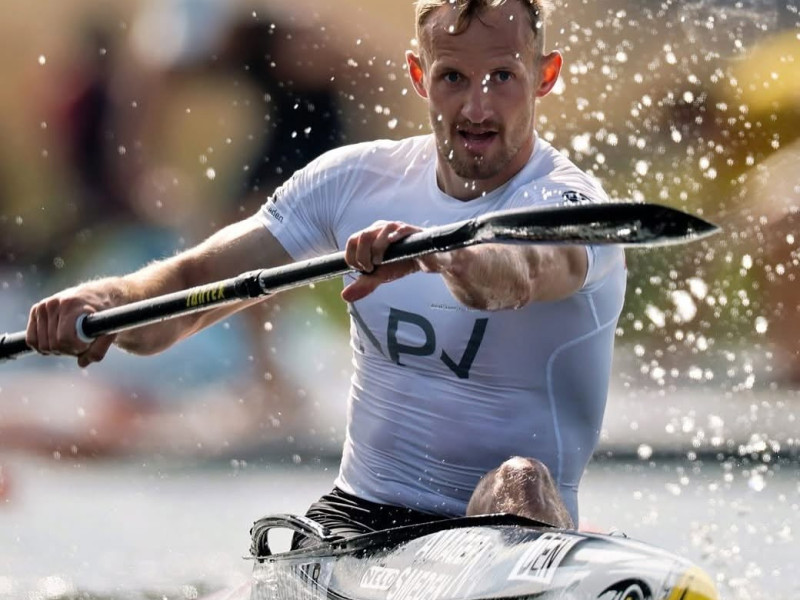
1. You return to Pitești, a venue that already marked an important chapter in your career with the 2021 world title. When you think back to racing there, what stands out most: the course itself, the atmosphere, or the way the races unfolded?
Pitești 2021 was incredibly special because it was the first major international competition after the COVID-19 lockdowns. Coming off my breakthrough season in 2019, I was highly motivated to get back out there and prove that I still had what it took after such a long racing hiatus. What stands out most from the main race was my partnership with Ivan Alonso. We had trained a lot together in Spain, and our cooperation during the long race was fantastic. Defending the gold medal meant the world to me. In the short race, I took silver behind José Ramalho, which only gave me more hunger for the long race—which, to me, is always the ultimate discipline. It’s also an interesting venue with a long, demanding portage.
2. Canoe marathon has changed significantly in the last decade — faster races, more aggressive tactics, shorter reaction times. From your perspective, is today’s marathon paddler fundamentally different from the athlete the discipline required ten years ago?
The sport has definitely evolved through different eras, but at the end of the day, I focus on racing my own way. I’ve always looked up to the sport's greatest champions. My mentor, Thor Nielsen—who is a World Champion himself—supports me and continues to show me the way. I’ve closely studied him and the generations before me. We have seen a generation where tight tactical positioning and pure top-end speed were everything. However, I have chosen a style where I am never afraid to hit the front and grind it out alone if that is what it takes to win.
3. Denmark continues to remain one of the strongest marathon nations despite its relatively small size. In your opinion, what separates countries that consistently produce world-class marathon athletes from those that struggle to stay competitive internationally?
In many national federations, there is an exclusive, almost extreme focus on the Olympic Games, meaning young paddlers are rarely introduced to the incredible opportunities within marathon racing. But one doesn't have to exclude the other—I race sprint as well especially 1000m and 5000m, and the two disciplines, sprint and Marathon, actually complement each other very well. For me, marathon is by far the most interesting discipline. There is a unique camaraderie, we get to race at very different venues, and there are so many historic races around the world. I was lucky enough to have great role models who inspired me early on to focus on marathon—a discipline that naturally suits me perfectly, both physically and mentally.
4. European marathon racing is probably deeper now than ever before, with medals becoming harder to predict and margins becoming increasingly small. Do you feel the European Championships today can be almost as demanding as a World Championships?
Europe is undeniably a powerhouse continent in kayaking, and the field of competitors here is incredibly deep. However, while a European Championship is brutal, you cannot overlook the global landscape. Nations like South Africa and Argentina are historically known for producing some of the absolute toughest marathon racers in the world, backed by a massive domestic marathon culture. So while Europe is elite, the World Championships still add that extra global weight.
5. You have competed through different eras of the sport and seen marathon evolve both competitively and commercially. From an athlete’s perspective, what do you believe marathon kayaking still lacks to become more attractive to broader audiences and media?
Our sport has massive untapped potential. Fortunately, live streaming has improved immensely, and drone footage has been a game-changer for showing the tactical chess match on the water. High-quality production is absolutely vital to make it viewer-friendly. I would love to see real-time data added to the screen, like live heart rates and other athlete metrics. Commentators also make or break the experience—guys like Stefan Gustavson and Ivan Lawler have done an incredible job making the races thrilling for the viewers.
Commercially, we could look into a city-center league. We could even return to the classic, long one-loop courses from the past; with modern technology, it’s now much easier to cover an expansive course than it used to be. I also love the idea of an 'open registration' format, similar to major running marathons. Put the national teams on the front start line, but let masters and the open classes mass-start right behind them. That mix of elite drama and mass participation could really elevate the sport's appeal.
6. Sports presentation has become a major topic across international sport — live coverage, storytelling, athlete visibility, broadcast production, fan engagement. What do you think canoe marathon currently does well, and where do you think Europe still needs to improve?
Honestly? A behind-the-scenes Netflix-style docuseries would be the ultimate way to showcase the grit of this sport! But joking aside, we have the raw drama; we just need to keep refining how we package the athletes' personal journeys to the public.
7. Some athletes say marathon is one of the purest forms of canoe sport because it exposes every weakness: endurance, technical ability, tactics, portages and mental resilience. What part of marathon racing still punishes athletes the most at elite level?
It’s the total package. At the elite level, you are operating at your absolute physical limit, but the sport simultaneously demands flawless tactical awareness and technical precision on the portages. The moment your focus slips in any of those areas, the sport punishes you instantly.
8. You’ve raced in many different countries and championship environments. What makes a marathon event memorable for athletes beyond simply the race result itself?
Venues are completely defined by their atmosphere. When we race in places with a deep-rooted culture for marathon racing, the energy is unmatched. Running through a portage that is packed with passionate fans feels like hitting a literal wall of sound. It gives you goosebumps and unlocks an extra gear you didn't know you had. That feeling stays with you long after the race is over.
9. Younger athletes entering the sport today are growing up watching established names like yourself competing year after year at the highest level. Do you feel marathon has become better at building athlete personalities and rivalries, or is that still something missing in the discipline?
I think there is definitely still room for improvement. The sport has so many strong personalities and deep rivalries, but it is a narrative that we could cultivate and market much more intensely to engage the fans.
10. Looking ahead to the European Championships in Romania, what are your goals for this competition? Also tell us your opinion on the short race as well as the 5000 meters in Sprint and comparison between both, if possible.
My goal never changes: I always race to win. Even with my favorite new title this year—being a father to our daughter, Vega—my competitive drive is exactly the same. I have a lot on my plate right now, as I am actively training to develop my 1000m speed while also racing the 5000m in sprint to gather crucial points for Olympic qualification. All of this sprint training is also a major stepping stone toward next year, where the Marathon World Championships will be held on my home water in Silkeborg, Denmark—a massive goal of mine.
It can be a bit funny to explain the difference to outsiders, given that the 'short race' in marathon is actually shorter than the 'long race' in sprint! But they require different tactical mindsets. The Marathon Short Race is pure chaos and intensity with the portages, while the 5000m sprint is about raw, continuous power. I thoroughly enjoy both disciplines and love how they push me to become a more complete athlete.


© 2021 ECA