Across the entire competition, European nations collected 43 medals, significantly ahead of the 24 medals won by non-European continents. More importantly, Europe once again demonstrated not only its ability to win, but also the extraordinary depth of its competitive structure, with podium finishes spread across a wide range of countries and boat categories.
While China ultimately finished at the top of the overall medal standings, Hungary emerged as the collective European powerhouse of the regatta, delivering one of the most complete performances of the competition in front of a home crowd.
Hungary confirms its depth on home water
Competing in Szeged, one of the spiritual homes of sprint canoeing, Hungary once again showcased the strength of its long-established development system.
The Hungarian team consistently reached finals across kayak and canoe disciplines, in both men’s and women’s events, and in individual as well as crew boats. Unlike nations whose success relied on isolated performances, Hungary’s results reflected a fully structured high-performance program capable of producing medals across the entire spectrum of the sport.
That collective consistency was decisive in allowing Hungary to finish second overall behind China and to establish itself as the leading European nation of the championships.
Europe clearly ahead of the rest of the world
The numbers underline Europe’s superiority throughout the regatta.
Overall medal totals
- Europe: 43 medals
- Non-European continents: 24 medals
Olympic events
- Europe: 19 medals
- Non-European continents: 8 medals
Non-Olympic events
- Europe: 24 medals
- Non-European continents: 16 medals
The gap was particularly significant in Olympic disciplines, where Europe more than doubled the medal output of the rest of the world combined. This reinforces a trend already visible over recent Olympic cycles: while global competitiveness continues to increase, Europe remains the central performance hub of elite sprint canoeing.
Another key factor was the distribution of results. European medals were spread across numerous nations, highlighting the continent’s broader competitive ecosystem rather than dependence on one or two dominant programs.
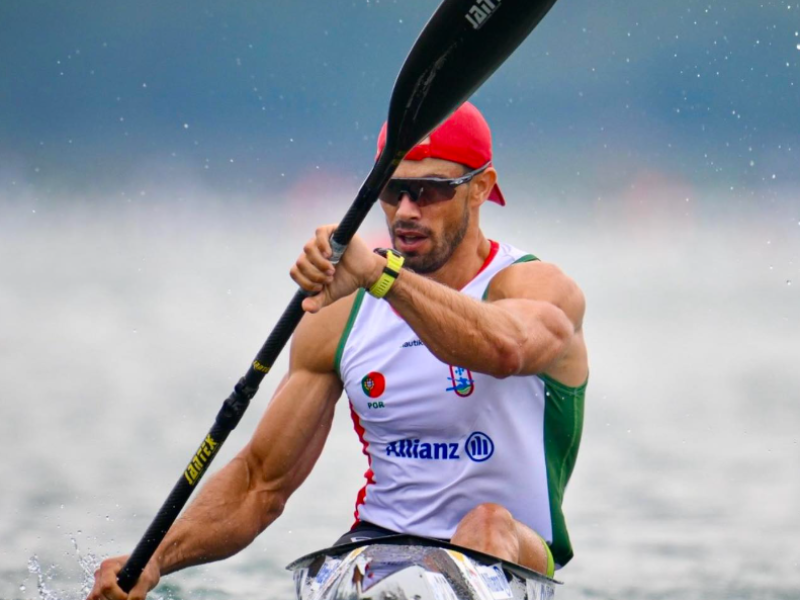
Fernando Pimenta delivers the standout individual performance
Among all athletes competing in Szeged, Fernando Pimenta produced arguably the most remarkable individual performance of the championships.
The Portuguese star won two Gold medals, one in K1 Men 1000 and second in K1 Men 5000.
What separates Pimenta from every other athlete at the regatta is that he was the only competitor to win multiple Gold medals exclusively in individual events.
In a sport increasingly dominated by crew boat specialization and highly targeted event preparation, winning multiple individual world-class races demands exceptional endurance, technical consistency, tactical intelligence and recovery capacity.
Pimenta’s achievement therefore stands apart not only statistically, but also in terms of sporting difficulty.
Other two athletes secured two Gold medals, comining individual and crew boats, ther were Mengya Sun (China) and Liudmyla Luzan (Ukraine).
A European statement ahead of the next international cycle
Beyond the medal table itself, Szeged 2026 reinforced a broader reality within world canoe sprint: Europe continues to set the competitive benchmark.
From Hungary’s collective strength, to Portugal’s elite individual performances, to the consistency shown by multiple European federations across Olympic disciplines, the championships offered another demonstration of the continent’s depth and structural advantage.
With the next major international events approaching, Europe leaves Szeged not simply with the highest medal total, but with a clear statement of sustained competitive leadership in global canoe sprint.
 10.5.2026