We use cookies to improve our site and your experience. By continuing to browse our site you accept our cookie policy
We use cookies to improve our site and your experience. By continuing to browse our site you accept our cookie policy
 3.7.2026
In 2026, that role will once again be in focus as Szeged prepares to host the 2026 Paddle Europe Juniors & Under 23 Sprint Championships in July. The event comes at a time when Hungarian canoeing continues to confirm its strength on the water, following another impressive period at European level in both sprint and marathon.
But Hungary’s story is not only about medals. Behind the results is a national system built on tradition, structure and long-term investment. It is also a system that is now facing the same challenges as many other European federations: generational change, financial sustainability, the need to diversify, the development of new disciplines, and the importance of keeping canoeing attractive in a rapidly changing sporting landscape.
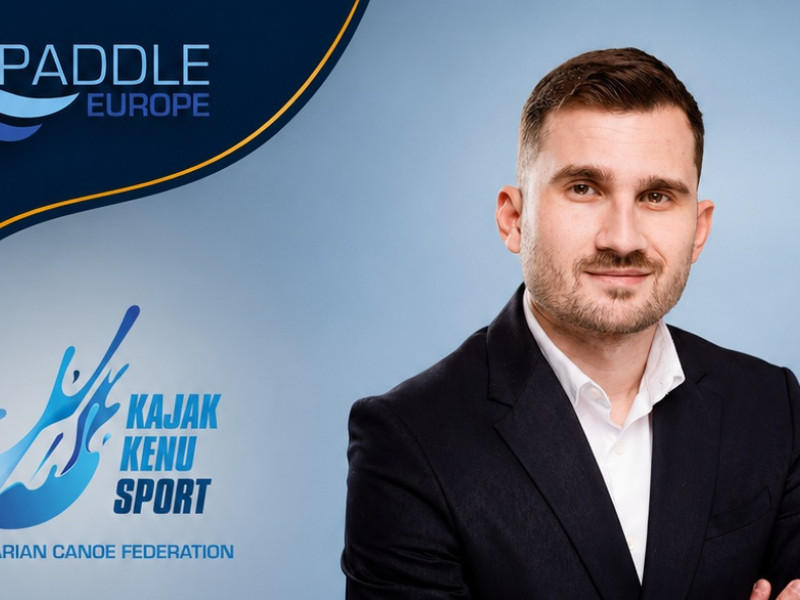
As part of a new Paddle Europe interview series dedicated to presenting Europe’s National Federations, their different realities, structures, ambitions and challenges, we spoke with Szakács Bálint, Secretary General of the Hungarian Canoe Federation, about the foundations of Hungary’s success and the future of canoeing in Europe.
For Szakács Bálint, the long-term consistency of Hungarian canoeing begins with culture.
Hungary’s success has been built over several generations, with Olympic and World Champions becoming role models for young athletes across the country. This creates a strong connection between canoeing and Hungary’s sporting identity, helping young paddlers understand from an early age that they are entering a sport with history, ambition and national importance.
This tradition has created a powerful cycle. International success helps maintain public interest, media attention and institutional support. In turn, this support strengthens the sport and creates the conditions for new generations of athletes to succeed.
But tradition alone is not enough. One of the central messages from the Hungarian Canoe Federation is that long-term success requires continuous development. Hungary respects its history, but it is also working to modernise its training systems, athlete development programmes and organisational structure.
In an international environment that is becoming more competitive every year, innovation is no longer optional. It is one of the key factors that will continue to separate leading nations from the rest.
One of Hungary’s greatest strengths is its nationwide club network.
The Hungarian Canoe Federation works with around 150 clubs across the country and more than 5,000 licensed athletes. Many of these clubs have decades of history and strong local communities, allowing the federation to identify talent early and provide a structured pathway from grassroots participation to elite performance.
At the centre of this structure are the coaches. In the Hungarian model, coaches are considered the cornerstone of the entire system. Their technical knowledge, practical experience and ability to guide athletes through different stages of development are essential to the country’s success.
For this reason, the federation continues to invest in coach education and in building a sustainable career model for coaches. This is one of the most important challenges for the future, especially as clubs face increasing financial pressure and as coaches must be encouraged to remain in sport rather than move into other professional areas.
Although Canoe Sprint remains Hungary’s flagship discipline, the federation’s activity now extends across several areas of paddlesport.
Today, the Hungarian Canoe Federation supports Canoe Sprint, Canoe Slalom, Paracanoe, Canoe Marathon, SUP, Dragon Boat, Wildwater Canoeing, Canoe Polo and recreational paddlesport activities.
This broader approach reflects a modern vision of what a national federation can be. Elite results remain extremely important, but the development of the sport also depends on grassroots participation, youth programmes, recreational opportunities and stronger connections with schools, local communities and regional centres.
One of the most important elements in this structure is the Regional Academy System. Launched in 2017 and later developed into a nationwide network, the system supports the long-term development of young athletes while creating a professional cooperation platform for clubs, coaches and experts.
Its value is not only organisational. It also helps create a common professional approach across the country, encouraging knowledge-sharing and cooperation between regions.
Hungary is internationally recognised above all for its Canoe Sprint and Canoe Marathon success, but the federation is also investing more seriously in disciplines where the country has less historical tradition.
Canoe Slalom is one of the clearest examples.
Hungary is not traditionally regarded as a slalom nation, and its natural conditions have not historically favoured the discipline in the same way as in other countries. Nevertheless, because Slalom is an Olympic discipline, the federation believes it is important to gradually strengthen its presence.
The opening of a new training course in Dunaremete has created new development opportunities, while several clubs are now working more seriously with the discipline. Hungary is also developing athletes, judges and event organisation experience in the slalom and wildwater communities.
Paracanoe is another strategic priority. For the Hungarian Canoe Federation, the discipline represents more than sporting success. It also reflects important social values such as inclusion, accessibility and equal opportunity.
SUP is also seen as a discipline with strong potential, especially from a grassroots and recreational perspective. It is accessible, popular among younger generations and can help introduce new people to the paddlesport community.
Marathon and Dragon Boat also remain important parts of the federation’s wider sporting landscape, with strong communities and significant potential to contribute to the visibility and growth of canoeing.
The Hungarian Canoe Federation currently operates with a diversified financial structure, although public support remains a major pillar. State support is especially important for elite sport, youth development, coaching programmes and strategic development initiatives.
At the same time, the federation also generates revenue through sponsorship, event organisation, membership-related income and development projects.
One of the federation’s strengths is that its financial model is not based only on Olympic preparation. Large-scale grassroots, educational and recreational programmes, together with major international events hosted in Hungary, help create a broader foundation for the sport.
However, sustainability remains a major challenge.
Clubs face increasing operational costs, infrastructure needs and staffing pressures. For this reason, the federation is encouraging clubs to become more financially diversified and independent, building models based on memberships, local partnerships, events, sponsorships and recreational programmes.
Another challenge is the changing lifestyle of younger generations. Like many sports across Europe, canoeing now competes with digital entertainment and many other activities. Attracting and retaining young athletes requires new communication methods, modern approaches and a stronger ability to connect with young people.
At elite level, the challenge is also increasing. International competition is becoming stronger every year, and the difference between success and failure is smaller than ever. This means that innovation in coaching, sports science, athlete management and performance analysis will continue to be decisive.
Hungary’s perspective also reflects a wider European reality.
Europe continues to dominate international canoeing across many disciplines, supported by history, strong competition structures, developed coaching systems and investment in Olympic sport. European athletes benefit from frequent high-level international competition, which helps raise standards across the continent.
But Europe cannot take this position for granted.
Other regions are developing quickly. Asian nations, especially China and emerging countries in Southeast Asia, are investing heavily in infrastructure, technology and athlete development. Australia and New Zealand also remain highly competitive and innovative.
For Szakács Bálint, this growing international competition is a positive force. It pushes Europe to keep improving and reminds leading nations that success must be earned continuously.
At the same time, he believes European federations must work together more closely. A strong global canoeing movement requires a strong and united Europe.
As one of the key organisers of major international canoeing events, Hungary is also aware of how much the expectations around competitions have changed.
Today, organisers must deliver not only excellent sporting conditions, but also strong digital communication, high-quality media production, sustainability standards, spectator experience and complex logistics.
Events are no longer only competitions. They are international products that must be presented professionally to athletes, partners, broadcasters, sponsors and spectators.
This is one of the key challenges for the future of canoeing in Europe. If the sport wants to remain attractive within the Olympic movement and grow its global visibility, it must continue to improve the quality and consistency of its events, broadcasts and athlete promotion.
The 2026 Paddle Europe Sprint Championships in Szeged will therefore be more than another major competition. It will be another opportunity for Hungary to showcase its experience, its standards and its role within European canoeing.
Hungary’s long-term vision is clear: to remain globally competitive while becoming more modern, inclusive and sustainable.
The federation wants to continue producing world-class athletes, but also strengthen grassroots participation, recreational paddlesport and community engagement.
At the same time, the future of canoeing will depend on diversification. Traditional disciplines will remain central, but new formats, urban events, digital communication and recreational opportunities will become increasingly important in attracting younger generations.
Hungary’s model shows that success is not built only at the top. It begins in clubs, with coaches, in communities and through long-term structures that connect young athletes to elite performance.
As Paddle Europe continues to present the realities of its National Federations, Hungary offers one of the clearest examples of how tradition and innovation can work together.
Its history is already one of the strongest in world canoeing. Its future will depend on the same qualities that built that history: structure, ambition, adaptation and a deep belief in the value of the sport.
Following this overview of the Hungarian canoeing model, Paddle Europe presents the full interview with Szakács Bálint, Secretary General of the Hungarian Canoe Federation.
The conversation offers a deeper look into the structure behind Hungary’s long-term success, the role of clubs and coaches, the federation’s investment in new disciplines, the challenges facing canoeing today, and the importance of stronger European cooperation for the future of the sport.
Paddle Europe: Hungary has been one of the world’s leading canoeing nations for decades. What do you believe are the key factors behind the long-term success and consistency of Hungarian canoeing?
Szakács Bálint: Hungarian canoeing has a very strong tradition and culture that has been built over several generations. Success is deeply rooted in our sporting identity, and many young athletes grow up seeing Olympic and World Champions as role models. This creates strong motivation from an early age.
Another key factor is the nationwide club system. We have around 150 clubs operating across the entire country, many of them with decades of history and strong local communities. This allows us to identify talent early and provide a structured pathway from grassroots participation to elite performance.
Coaching education and professional expertise also play a major role. In Hungary, the cornerstone of our entire system is the coaches. We invest significant resources into coach education and into creating a sustainable career model for them. In today’s rapidly changing world, this is an ongoing challenge, but thanks to the continuous support of the Hungarian Government, we have the opportunity to move step by step in the right direction and further strengthen the system.
Hungary has traditionally had highly respected coaches with strong technical knowledge and practical experience, and this knowledge has continuously been passed on to younger generations.
At the same time, international success has helped maintain institutional support, media attention and public interest. This creates a positive cycle where results strengthen the sport, and the sport creates the conditions for future results.
Finally, I believe one of our greatest strengths is the combination of tradition and innovation. We respect our history, but we are also constantly trying to modernise our training systems, athlete development programmes and organisational structure. This is especially important today because we can clearly see that the international field is becoming more competitive year by year.
Many countries have made significant progress, and in the future innovation will likely be one of the key factors that creates differences between nations. It is therefore our responsibility to continue developing and moving forward in this area as well.
Paddle Europe: Can you give us an overview of the current structure of the Hungarian Canoe Federation in terms of registered athletes, clubs, disciplines and national activity?
Szakács Bálint: The Hungarian Canoe Federation is one of the largest and most active sports federations in Hungary. We work with a nationwide network of approximately 150 clubs and more than 5,000 licensed athletes across multiple disciplines.
Canoe Sprint remains the largest discipline, but our federation today also includes Canoe Slalom, Paracanoe, Canoe Marathon, SUP, Dragon Boat, Wildwater Canoeing, Canoe Polo and recreational paddlesport activities.
Our activity is not limited to elite sport. A major focus is also grassroots participation, youth development and recreational sport. Every year we organise a large number of national competitions, youth programmes, talent identification initiatives, educational activities for coaches and officials, as well as numerous recreational sport events promoting active lifestyles and broad public participation in paddlesport.
We also place strong emphasis on cooperation with schools, local communities and regional centres in order to ensure that canoeing remains accessible throughout the country.
An important pillar of our development structure is the Regional Academy System, which has become one of the defining professional foundations of Hungarian canoeing’s youth development programme in recent years.
Since the launch of the regional structure in 2017, the system has continuously evolved, and by 2021 it had developed into a comprehensive nationwide network operating under unified professional principles, while also taking into account the specific characteristics and needs of each region.
The main objective of the system is to broaden the high-quality talent base and support the long-term, structured development of young athletes.
The regional academies are not only responsible for organising training camps and events, but also function as professional cooperation platforms where coaches, clubs and experts work together in a coordinated way and share knowledge and best practices.
Over time, it has become clear that the real added value of the system lies in this cooperation, knowledge-sharing and the creation of a common professional approach. The Regional Academy System is therefore not only an organisational framework, but also a continuously developing professional environment that supports the future success and sustainability of Hungarian canoeing.
Paddle Europe: Beyond Canoe Sprint, which disciplines are currently strategic priorities for the federation, and why?
Szakács Bálint: While Canoe Sprint remains our flagship discipline, we are increasingly focusing on diversification across several disciplines.
One important strategic area is Canoe Slalom. Traditionally, Hungary’s natural conditions and sporting heritage have not been built around slalom, so this discipline presents a different kind of challenge for us.
In the current Olympic cycle, we decided to place the development of Canoe Slalom on entirely new foundations under the leadership of our discipline manager, Sára Seprenyi.
It is also a great achievement for Hungarian canoeing that she currently serves as Chair of the Slalom Technical Committee at Paddle Europe, especially considering that Hungary is not traditionally regarded as a slalom nation.
Last year, a new venue in Dunaremete — primarily designed as a training course — was officially opened, and on June 5–6 this year it will also host an ICF Wildwater Canoeing World Cup event. Hungary already has extensive experience in organising major international competitions in other disciplines, but this will represent our first event of this scale within the slalom and wildwater community.
Paracanoe is also a major priority. Beyond sporting success, it represents important social values such as inclusion, accessibility and equal opportunity. We are proud of the progress Hungarian paracanoe has made in recent years, and a great deal of credit goes to Botond Hajdu, who serves both as a member of the ICF Paracanoe Committee and as Hungary’s Paracanoe Head Coach.
Alongside him, Weisz Róbert has also contributed enormously to the development of the discipline, first as national team head coach and currently as Chair of the Paracanoe Technical Committee at Paddle Europe.
SUP is another discipline with significant potential, especially from a grassroots and recreational perspective. It is accessible, popular among younger generations and can help introduce new participants to the paddlesport community.
We also believe SUP could eventually become part of the Olympic programme, which is why we dedicate considerable attention to its long-term development. After hosting the ICF SUP World Championships in 2021, Hungary will once again organise the event in 2028 in Balatonfüred.
We also continue to support Marathon and Dragon Boat, which have strong communities and contribute greatly to the overall development and visibility of the sport.
Paddle Europe: In recent years, Slalom appears to be receiving increased attention in Hungary. What motivated the federation to invest more seriously in this discipline?
Szakács Bálint: As I mentioned earlier, Hungary is not traditionally a Canoe Slalom nation. Neither our historical background nor our natural conditions have focused on this discipline in the same way as some other countries.
Nevertheless, Slalom is an Olympic discipline, and we believe it is important for Hungary to gradually strengthen its presence there as well.
At the moment, we are fortunate to have a very dedicated and enthusiastic representative of the discipline in Sára, who is doing tremendous work for Hungarian Slalom. The opening of the new training course has also created entirely new opportunities for development.
In addition, several Hungarian clubs have now started to work seriously with the discipline, and we already have young and motivated athletes whom we can send to international competitions — for now mainly to gain experience and learn the international environment step by step.
We believe that the slalom discipline offers new development opportunities for athletes, coaches and clubs. It broadens the technical and athletic profile of Hungarian canoeing and can attract new young athletes who may be interested in a different type of paddlesport challenge.
We are also building the broader ecosystem around the discipline. Hungary now has trained Slalom judges as well, and following this June’s ICF World Cup event, we would like to continue organising international competitions in the future.
At the same time, we are fully aware that this is a long-term process and a strategic investment for the future of Hungarian canoeing. We are approaching it step by step, with realistic expectations, but also with strong commitment and optimism for the future.
Paddle Europe: How is the federation financially structured today, and how important are international success and Olympic results for maintaining support and long-term sustainability?
Szakács Bálint: Today, the federation operates with a diversified but still predominantly publicly supported financial structure.
A significant part of our budget comes from direct state support connected to elite sport, youth development, coaching programmes and strategic sport development initiatives. At the same time, we also generate revenue through sponsorship, event organisation, membership-related income and EU-funded development projects.
One of the federation’s biggest strengths is that our financial model is not based solely on Olympic preparation. Alongside high-performance sport, we also operate large-scale grassroots, educational and recreational programmes, such as the Water Touring Programme, as well as major international events hosted in Hungary.
These programmes help create a broader and more sustainable foundation for the sport.
At the same time, Olympic and international success remain extremely important. In Hungary, Olympic sports receive significant public attention, and results strongly influence visibility, credibility and long-term institutional support.
Success helps us maintain strong relationships with government stakeholders, sponsors, clubs and the wider public. It also inspires new generations of athletes and helps keep canoeing among the leading sports in the country.
However, our long-term strategy today goes beyond medals alone. We invest heavily in coaching education, regional academies, athlete support systems, sports science, infrastructure development and recreational paddlesport programmes in order to build a stable and sustainable ecosystem for the future.
At the same time, we also encourage our clubs to become increasingly self-sustainable and financially diversified.
While state support has been extremely important for the development of Hungarian sport, we understand that its level may not always remain the same in the future. Fortunately, our clubs have many opportunities to generate their own revenues and operate on multiple pillars through memberships, events, sponsorships, recreational programmes and local partnerships.
Many clubs have already recognised this direction and are actively building more independent and sustainable models, while others are still in the process of adapting to this approach.
Our federation and our sport have always been able to adapt successfully to changing environments and different political or economic circumstances. I believe this adaptability has been one of the key reasons behind the long-term stability and success of Hungarian canoeing.
We are approaching the future with the same mindset: with openness, professionalism and confidence in our ability to continue building and developing the sport regardless of external changes.
Paddle Europe: What are currently the biggest challenges facing Hungarian canoeing, both at elite and grassroots level?
Szakács Bálint: One of the biggest challenges is the changing lifestyle of younger generations. Sport today competes with many other forms of entertainment and digital activity, so attracting and retaining young athletes requires new approaches and communication methods.
Another challenge is maintaining a strong club system while economic conditions are becoming more demanding. Clubs face increasing operational costs, infrastructure needs and staffing challenges.
Maintaining an attractive and sustainable coaching career pathway is also a major issue. It is important that coaches remain within the sport and do not leave for other civil professions due to financial or long-term career uncertainties.
Coaches are one of the most valuable assets of our system, so supporting and retaining them is essential for the future success of Hungarian canoeing.
At elite level, international competition is becoming stronger every year. The margins between success and failure are becoming smaller, which means continuous innovation is necessary in coaching, sports science and athlete management.
We also see the importance of balancing high-performance sport with long-term athlete wellbeing, education and career development.
Paddle Europe: Europe continues to dominate international canoeing across many disciplines. From your perspective, what allows European nations to remain ahead of the rest of the world?
Szakács Bálint: Europe benefits from a very strong historical tradition in canoeing, combined with highly developed competition structures and coaching systems.
European athletes have access to frequent high-level international competition, which accelerates development and raises standards across all disciplines. In addition, many European countries continue to invest significantly in Olympic sport infrastructure, athlete support systems and coach education.
At the same time, maintaining Europe’s dominance is becoming increasingly challenging.
The International Canoe Federation is strategically opening the sport towards new regions and new event locations, and the updated Olympic qualification system also encourages broader global representation.
These directions are understandable and important for the long-term future of canoeing, especially from the perspective of keeping the sport attractive and secure within the Olympic programme.
Today, global visibility, audience engagement and media value are becoming just as important as traditional sporting strength.
However, simply opening towards new territories and new markets will not be enough on its own. We must also raise the overall quality of our sport and its presentation.
That means continuously improving the standard of events and broadcasting, while also doing a much stronger job in promoting and communicating our star athletes and strengthening the overall canoeing brand.
Without this, the long-term future of our sport could become uncertain.
I also believe that European nations must work together even more closely in the coming years. Without a strong and united Europe, there will not be a strong global canoeing movement either.
Paddle Europe: At the same time, international competition is growing quickly outside Europe. Which countries or regions do you believe are developing most strongly for the future?
Szakács Bálint: We can clearly see rapid development in several parts of the world.
Asian countries, particularly China and some emerging nations in Southeast Asia, continue to invest heavily in canoeing infrastructure, technology and athlete development. Their progress in recent years has been extremely impressive.
At the same time, Australia and New Zealand remain highly competitive and innovative nations within our sport. They consistently produce world-class athletes and often bring very modern approaches to coaching, performance analysis and athlete preparation.
Their development is also a strong motivation for European nations like Hungary. It reminds us that we cannot relax for a single moment.
We must continuously search for opportunities to improve, embrace technological innovation and keep evolving in every aspect of high-performance sport.
But this is exactly how it should be — strong international competition is ultimately what drives the entire sport forward.
Paddle Europe: Hungary remains one of the key organisers of major international canoeing events. What are today the main challenges in hosting large international competitions compared with previous years?
Szakács Bálint: The expectations surrounding international events have increased significantly in recent years.
Today, organisers must deliver not only excellent sporting conditions, but also strong digital communication, media production, sustainability standards, spectator experience and complex logistical operations.
Financial pressure has also increased considerably. The costs of infrastructure, security, energy and event operations are much higher than before.
At the same time, international competitions are important opportunities to showcase both the sport and the host country.
Hungary has extensive experience in organising world-class events, and we remain committed to maintaining high standards.
As I mentioned earlier, it is also a clear priority for both the International Canoe Federation and Paddle Europe to continuously strengthen expectations towards organisers and further standardise the overall quality of events.
It is not beneficial for the sport if every international and continental competition is delivered at a completely different standard.
These events are ultimately the ICF’s and Paddle Europe’s own products, so it is extremely important that they are presented and marketed in a professional and consistent way to athletes, partners, broadcasters, sponsors and spectators alike.
Paddle Europe: Looking ahead to the future, what is your long-term vision for both Hungarian canoeing and the development of canoeing in Europe?
Szakács Bálint: Our vision is to ensure that Hungarian canoeing remains globally competitive while also becoming increasingly modern, inclusive and sustainable.
We want to continue producing world-class athletes, but at the same time strengthen grassroots participation, recreational paddlesport and community engagement.
We also believe the future of canoeing depends on diversification. Traditional disciplines will always remain central, but new formats, urban events, digital communication and recreational opportunities will play an increasingly important role in attracting younger generations.
At European level, I believe cooperation between federations will become even more important.
We must work together to strengthen the visibility of canoeing, modernise our events and ensure that our sport remains attractive within the Olympic movement.
Canoeing has a unique combination of tradition, nature, performance and accessibility.
If we continue to evolve while preserving these core values, I believe the future of the sport is very strong.


© 2021 ECA