We use cookies to improve our site and your experience. By continuing to browse our site you accept our cookie policy
We use cookies to improve our site and your experience. By continuing to browse our site you accept our cookie policy
 5.7.2026
Across the full competition programme, European countries won 100 medals, including 29 gold medals, once again showing the important role of Europe in the development of international canoe sprint at junior and under-23 level.
The standout nation was clearly Hungary, which finished on top of the medal table with an impressive total of 27 medals, including 11 gold, 10 silver and 6 bronze. The Hungarian team showed remarkable consistency across kayak and canoe events, individual races and crew boats, confirming its position as one of the strongest canoe sprint nations in the world.
Hungary’s success was built across the full programme, with victories in events such as the K4 Junior Men 500m, K4 Junior Women 500m, K4 Under 23 Men 500m, C4 Under 23 Men 500m, K1 Under 23 Women 1000m, K1 Under 23 Men 1000m, K1 Junior Women 200m, C2 Junior Men 500m, C2 Under 23 Men 500m, K2 Junior Women 500m and K2 Under 23 Men 500m.
This result confirms not only the quality of Hungary’s top athletes, but also the depth of its system. The country reached the podium in many different boat classes and age groups, showing a balanced team capable of competing for medals across the entire championship programme.
Behind Hungary, Poland was another major European highlight. With 7 medals, including 3 gold, 1 silver and 3 bronze, Poland finished as the second European nation by gold medals. The Polish team claimed titles through Kacper SIERADZAN in the C1 Under 23 Men 1000m, Alex BORUCKI in the K1 Under 23 Men 500m, and the women’s K2 crew of Weronika MARCZEWSKA and Martyna JASKOLSKA in the K2 Under 23 Women 500m.
Poland also showed strong depth in crew boats, with a silver medal in the K4 Under 23 Men 500m and bronze medals in the C4 Junior Men 500m, K1 Under 23 Women 1000m and K1 Junior Mix 5000m. Alex BORUCKI and Weronika MARCZEWSKA were two of the key names for the Polish team, both finishing the Championships with two medals.
Slovakia also produced one of the strongest European gold-medal performances, finishing with 3 gold medals. The Slovak team was led by Alex GAVLIDER, winner of the K1 Junior Men 200m, and by Bianka SIDOVA, who claimed gold in the K1 Under 23 Women 500m and was also part of the winning K4 Under 23 Women 500m crew. Slovakia ended the Championships with 5 medals in total, confirming a very successful campaign.
Germany was one of the most consistent European nations in Halifax. Although Germany finished with only 2 gold medals, the team collected 15 medals in total, the second-highest total among European countries. German athletes reached the podium across many different events, particularly in crew boats, and also claimed gold through Carlotta LOSKE in the C1 Under 23 Women 500m and the mixed crew of Lykka STROBEL and Moritz HAASE in the C1 Junior Mix 5000m.
Czechia also had a strong championship, finishing with 8 medals, including 2 gold, 3 silver and 3 bronze. Czech success came early with Adam RUDOLF winning the C1 Under 23 Men 500m, while Barbora JANOTOVA added another title in the K1 Junior Women 1000m. The Czech team also reached the podium in canoe and kayak events, showing good balance across disciplines.
Ukraine finished with 7 medals, including one of the most impressive individual European performances of the Championships. Iryna FEDORIV won three medals, taking gold in the C1 Under 23 Women 200m and silver in both the C2 Under 23 Women 500m and C2 Under 23 Women 200m, alongside Iryna NEDILKO in the crew events. FEDORIV was the only European female athlete to reach three medals in Halifax, placing her among the most successful athletes of the entire competition.
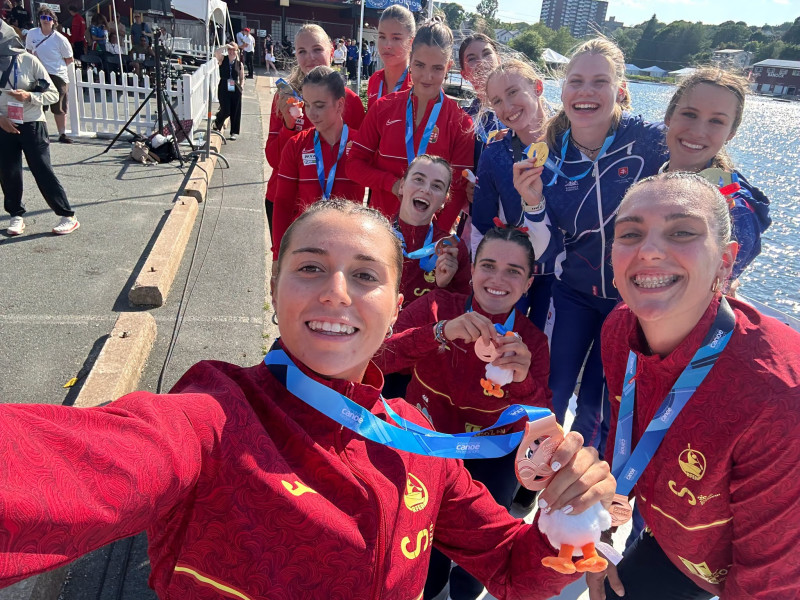
Spain finished with 11 medals, one of the highest European totals, with strong results across canoe and kayak crew boats. Spain’s gold medal came through Raul FERNANDEZ in the C1 Under 23 Men 200m, while the Spanish team also collected several bronze medals in junior and under-23 events, confirming the strength of its wider squad.
Other European nations also had important moments. Denmark won two gold medals in the mixed 5000m events, Portugal celebrated gold in the K2 Junior Men 500m through Jose MATOS and Martim CONCEICAO, Ireland took gold with Sean BUTTERLY in the K1 Junior Men 1000m, and Slovenia won the K1 Under 23 Men 200m through Matevz MANFREDA.
There were also podium results for countries such as Great Britain, Italy, France, Moldova, Serbia, Georgia and Türkiye, showing the wide European representation across the medal events. Türkiye’s Rahmi KARAHAN was one of the individual stars of the Championships, winning three medals in the junior men’s kayak events, including gold in the K1 Junior Men 500m.
Overall, the 2026 ICF Junior and U23 Canoe Sprint World Championships confirmed once again the strength of European canoe sprint. Hungary led the way with a dominant medal table victory, but the results also highlighted the growing depth of countries such as Poland, Slovakia, Germany, Czechia, Ukraine and Spain.
The performances in Halifax now create a perfect link to the next major moment of the European season: the 2026 Paddle Europe Junior and Under 23 Sprint Championships, which will take place in Hungary in two weeks’ time.
With Hungary arriving as the leading nation from the World Championships, and with strong momentum from Poland, Slovakia, Germany, Czechia, Ukraine, Spain and many others, the European Championships promise to be one of the most exciting events of the season.
After Halifax, all eyes now turn to Hungary, where Europe’s best junior and under-23 athletes will meet again — this time to fight for continental titles.


© 2021 ECA