We use cookies to improve our site and your experience. By continuing to browse our site you accept our cookie policy
We use cookies to improve our site and your experience. By continuing to browse our site you accept our cookie policy
 21.6.2026
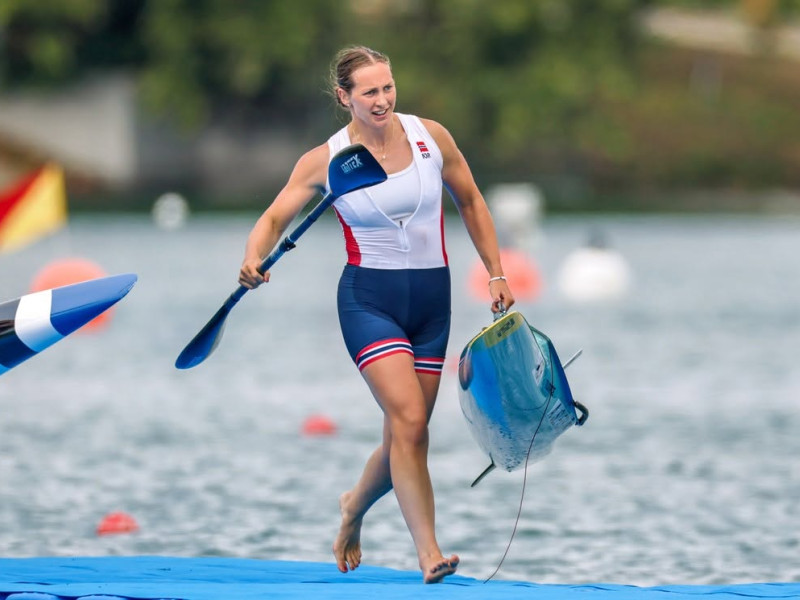
1. Last season was remarkable for you across both sprint and marathon disciplines — from competing at the Paris Olympic Games in K4 to becoming European Champion in marathon. How difficult is it to balance two disciplines that increasingly demand very different athlete profiles?
I think biologically I’m probably built more for longer distances and the demands of marathon racing. What doesn’t come as naturally to me is the speed needed at the start and being able to respond to attacks without it costing too much energy. Sprint training has definitely helped me improve those parts of my racing.
At the same time, there are actually a lot of similarities between marathon and sprint training. For me, the most important thing has always been to keep developing as a paddler and as an athlete. I think the work I do in one discipline often helps me in the other as well.
2. Norway had no female canoe sprint athletes at the Olympic Games between Barcelona 1992 and Paris 2024. What makes the story even more unique is that in Barcelona, the Norwegian K4 also included your mother, Ingeborg Rasmussen. How do you reflect on becoming part of that Olympic history across two generations of the same family?
This might sound a bit strange, but the Olympics are actually quite normalised in my family. Not only my mother, but also my father, Arne Sletsjøe, my uncle, Einar Rasmussen, and my aunt, Tone Rasmussen, all competed at the Olympic Games.
Because of that, I don’t think too much about the history aspect on a daily basis. What I appreciate most is having so many people around me who understand what it takes. They know the ups and downs of elite sport, and they’re always willing to help, whether that’s joining me for a training session, offering advice, or just being there when I need support.
3. Both of your parents competed internationally in canoe sprint, with your father Arne Bernhard Sletsjøe racing at the Los Angeles 1984 and Seoul 1988 Olympic Games. Growing up in that environment, did canoeing always feel natural to you, or was there a moment where the sport truly became your own ambition rather than family legacy?
I grew up around kayaks and spent a lot of time in boats from a young age, so paddling always felt very natural to me.
But it was never something I was pushed into. I kept doing it simply because I enjoyed it.
4. You have already experienced Olympic sprint racing and top-level marathon competition at a young age. From an athlete’s perspective, what are the biggest differences mentally between preparing for a sprint championship and preparing for a major marathon event?
In sprint, you need a clear plan for how you’re going to race from start to finish and then just stick to it. Marathon is more about adapting to whatever happens and making the right decisions along the way.
I’ve always found marathon quite easy to prepare for mentally as long as I feel good physically. I mostly race on instinct and know that no matter what you think is going to happen before the start, the race usually turns out completely different anyway. Sprint is more predictable and maybe a bit less exciting to prepare for. It’s mostly about doing the same things over and over again until you can do them exactly the way you want to on race day.
5. Women’s marathon racing has become increasingly tactical and physically intense in recent years. Do you feel the level in Europe today is stronger and deeper than when you first entered senior competition?
Definitely. I think the level at the top has been high for a long time, but the field is getting stronger and stronger. We’re also seeing new countries showing up on the start line all the time.
6. Marathon racing often produces dramatic races with attacks, positioning battles and mistakes that completely change outcomes. Yet the discipline still struggles at times for mainstream visibility. What do you think canoe marathon still needs in terms of sports presentation and storytelling to attract wider audiences?
The best livestream productions are already very good, and I think it’s important to keep that standard high. At the same time, I think the sport needs a bigger reach on social media and has to meet people where they are, on platforms like TikTok and Instagram.
The location of events can also make a big difference. When possible, I think it’s great to bring races into city centres, like in Győr, where it’s easier for people to discover the sport and follow the action.
There’s a lot of competition for people’s attention, but I think canoe marathon has all the ingredients needed to be a really entertaining sport to watch.
7. Across Europe there is growing discussion about how paddle sports should present athletes and personalities to the public. Do you think marathon has improved in building recognisable athlete stories and rivalries, or is there still too much focus only on results?
I think there has definitely been more focus in recent years on getting to know the athletes and understanding how they race and approach competitions.
One thing that could maybe be highlighted more is the friendships between athletes from different countries. Even more than in sprint, some of my biggest competitors are also good friends. I genuinely want them to do well and win races, but once the race starts it’s full race mode. Then as soon as we cross the finish line, we’re friends again.
It’s quite common to have conversations after a race like “sorry I pushed you wide at that buoy” or “I wish there had been room for you in that group”. We’re ruthless on the water, but that doesn’t stop us from being friends off it.
8. The European Championships return this year to Pitești, a venue already strongly connected to sprint and marathon history. As an athlete, how important is it for championships to have atmosphere, identity and strong crowd engagement rather than simply a good race course?
A good course makes racing enjoyable and challenging, and forces you to think about how to manoeuvre and find the best tactics. Good atmosphere, crowds and engagement give you that feeling in your stomach that makes you want to squeeze out every last bit of energy you have.
Ideally, you want both. A great course makes for a great race, but a great atmosphere is what makes a championship feel special.
9. Many athletes describe marathon as the most demanding discipline in canoeing because it exposes every weakness — endurance, technique, tactics, portages and mental resilience. What aspect of marathon racing do you personally find hardest to master consistently?
I have to admit that long portages are probably not my favourite part of marathon racing. Getting in and out of the boat is fine, but the running itself is definitely one of my weaker areas.
I would also struggle to race the way athletes like Mads Brandt Pedersen or Melina Andersson sometimes do, setting the pace from the front and holding a high speed on their own. The more tactics, positioning, attacks and surprises there are in a race, the more I enjoy it.
10. Looking ahead to Romania, what are your goals for 2026 European Championships ?
Not any worse than last year ;)


© 2021 ECA